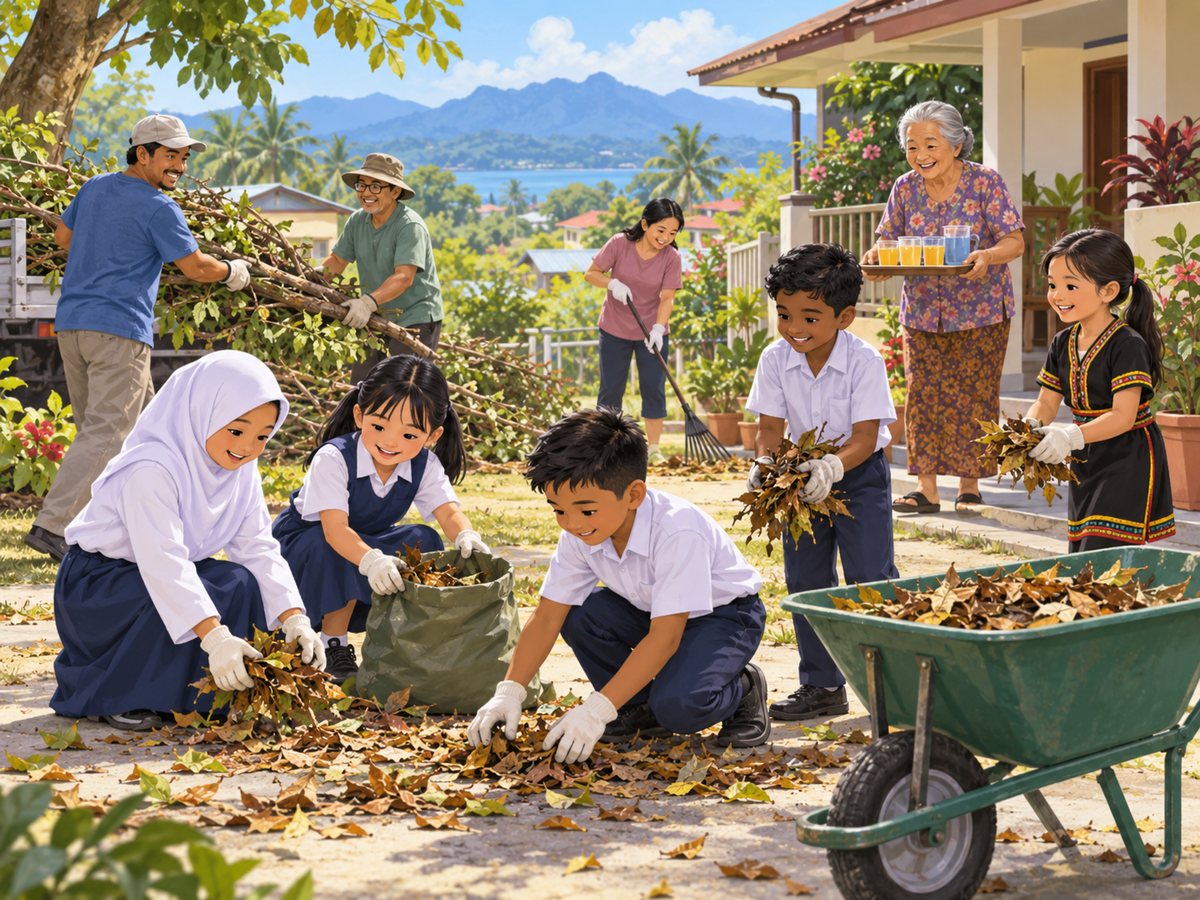
Hujan lebat turun sepanjang malam di Kampung Inanam. Air mula naik di jalan. Penduduk segera bekerjasama: ada yang mengangkat barang, ada yang memindahkan warga emas ke dewan. Mengapakah kerjasama penting pada saat seperti ini?
cooperation = kerjasama
Cooperation means everyone working together and sharing tasks towards a common goal. In an emergency or when holding an event, neighbours who cooperate get things done faster, better and more safely. This unit covers cooperation among neighbours and how it differs from looking after only ourselves.
Example: when heavy rain floods the village, residents carry belongings together and move the elderly to the hall.
Watch out: children can contribute too, within safe limits.
Kenali
Muafakat membawa berkat
Peribahasa “muafakat membawa berkat” bermaksud kerja yang dilakukan bersama-sama dengan sepakat akan membawa kebaikan.
Contoh: Penduduk membina pagar taman permainan bersama-sama. Kerja yang berat siap dalam sehari sahaja.
同心协力带来福气 = muafakat membawa berkat
这句马来谚语的意思是:大家同心(sepakat)一起做事,就会带来好处。很重的工作,分给很多人就变轻了,也更快完成。
例子:居民一起建游乐场的围栏,一天就完成了。
注意:合作要先商量好,大家意见一致才不会乱。
agreement brings blessing = muafakat membawa berkat
This Malay proverb means that work done together in agreement (sepakat) brings good results. A heavy job becomes light when shared among many people and gets done faster.
Example: residents build the playground fence together and finish it in a single day.
Watch out: discuss and agree first, so the work does not become messy.
Semak kefahaman
Apakah maksud peribahasa “muafakat membawa berkat”?
understanding the proverb = fahami peribahasa
'Muafakat' means agreeing together; 'berkat' means blessing or benefit. Put the two words together: what is the proverb telling us?
Example: the whole class decorates the classroom together, finishing quickly and beautifully.
Watch out: this proverb is about a team, not one person.
Fahami
Bekerjasama menjaga keselamatan
Jiran boleh bekerjasama menjaga keselamatan kawasan, contohnya melalui Skim Rondaan Sukarela (SRS).
Contoh: Ayah Kevin dan beberapa jiran meronda kawasan perumahan pada waktu malam secara bergilir-gilir. Kes kecurian semakin berkurang.
keeping safe together = bekerjasama menjaga keselamatan
Neighbours can keep the area safe together, for example through the Voluntary Patrol Scheme (Skim Rondaan Sukarela, SRS), taking turns to patrol at night. When everyone watches out, criminals find it harder to strike.
Example: Kevin's father and some neighbours patrol the estate at night in turns, and thefts become fewer.
Watch out: children do not join night patrols, but they can tell adults about anything suspicious they see.
Semak kefahaman
Apakah kebaikan penduduk bekerjasama melalui rondaan sukarela?
the benefit of patrols = kebaikan rondaan
What is the main purpose of residents patrolling in turns? Focus on the idea of safety.
Example: with patrols, people walking home at night feel more at ease.
Watch out: even with patrols, doors must still be locked; safety depends on everyone.
Amalkan
Merancang projek bersama
Untuk projek komuniti, jiran berbincang, membahagikan tugas dan berkongsi kemahiran.
Contoh: Penduduk membina gazebo di taman. Encik Wong yang pandai bertukang membina rangka, Puan Lidia mengecat, dan kanak-kanak menanam pokok bunga.
一起策划 = merancang bersama
社区要做计划,例如盖凉亭、布置休闲角,要先一起讨论(berbincang),再按每个人的专长分工,互相分享技能(berkongsi kemahiran)。这样大家都有贡献,成果也更好。
例子:会做木工的王先生搭架子,莉迪亚太太油漆,孩子们种花。
注意:分工以后要互相配合,不能只顾自己那一份。
planning together = merancang bersama
For a community project, such as building a gazebo or a rest corner, neighbours first discuss (berbincang), then divide tasks by each person's strengths and share their skills (berkongsi kemahiran). Everyone contributes, and the result is better.
Example: Encik Wong, who is good at carpentry, builds the frame, Puan Lidia paints, and the children plant flowers.
Watch out: after dividing the work, coordinate with each other rather than minding only your own part.
Semak kefahaman
Penduduk mahu menghias dewan untuk majlis. Apakah langkah pertama yang baik?
合作的第一步 = langkah pertama kerjasama
很多人一起做事,如果没有先商量,就可能重复做、互相冲突。想一想哪一个做法让大家有方向、各有任务。
例子:开会决定谁负责灯饰、谁负责椅子、谁负责食物。
注意:只等别人开始,事情永远做不完。
the first step of teamwork = langkah pertama kerjasama
When many people work together without discussing first, they may repeat or clash. Think which action gives everyone direction and a clear task.
Example: holding a meeting to decide who handles lights, chairs and food.
Watch out: if everyone waits for others to start, the job never gets done.
Fikir
Bekerjasama atau mementingkan diri?
Jiran yang bekerjasama hidup harmoni dan masalah cepat selesai. Jiran yang mementingkan diri sendiri sering berasa terasing dan sukar mendapat bantuan.
Contoh: Di Lorong A, penduduk membersihkan longkang bersama. Di Lorong B, tiada siapa yang mahu membantu, lalu longkang tersumbat dan berbau.
合作与自私的对比 = bekerjasama atau mementingkan diri
愿意合作的邻居,生活和谐,问题很快解决;只顾自己的人,不参加社区的事,遇到困难时也比较难得到帮助。
例子:A 巷的居民一起清沟,B 巷没人愿意帮忙,结果水沟堵塞又发臭。
注意:社区是大家的,只靠少数人是不够的。
teamwork or selfishness = bekerjasama atau mementingkan diri
Neighbours who cooperate live in harmony and solve problems quickly; people who think only of themselves stay out of community matters and find it harder to get help when in trouble.
Example: in Lane A residents clean the drains together; in Lane B nobody helps, so the drain clogs and smells.
Watch out: the neighbourhood belongs to everyone; relying on a few people is not enough.
Semak kefahaman
Apakah yang mungkin berlaku di kawasan yang penduduknya tidak mahu bekerjasama?
缺乏合作的后果 = kesan tiada kerjasama
想象一个社区没人愿意出力:垃圾、水沟、损坏的设施会变成怎样?题目问的是不好的情况。
例子:没人愿意轮值清洁,公共厕所越来越脏。
注意:这题要选负面的结果。
without teamwork = kesan tiada kerjasama
Imagine a neighbourhood where nobody will help: what happens to the rubbish, drains and broken facilities? The question asks for a bad situation.
Example: when no one takes a cleaning turn, the public toilet gets dirtier and dirtier.
Watch out: choose a negative result here.
Amalkan
Bekerjasama menyambut perayaan
Semasa perayaan, jiran pelbagai kaum boleh membuat jadual tugasan bersama. Ini juga cara menghargai tradisi jiran.
Contoh: Untuk Pesta Tanglung, Kevin dan kawan-kawannya membuat tanglung, ibu-ibu menyediakan kuih bulan, dan bapa-bapa menyusun lampu.
celebrating together = bekerjasama menyambut perayaan
For a community festival, neighbours of different races can draw up a task schedule (jadual tugasan) together, each handling a part. Preparing together also helps everyone appreciate each other's traditions.
Example: for the Lantern Festival, the children make lanterns, the mothers prepare mooncakes and the fathers hang the lights.
Watch out: a task schedule should state clearly who does what and when.
Padankan
Padankan ahli dengan tugasan yang sesuai untuk majlis kejiranan
按能力分工 = bahagi tugas ikut kemampuan
好的合作,会让每个人做适合自己的工作:小孩做轻松安全的事,年轻人做需要力气的事,父母负责煮食,年长者可以做接待。先想一想每个人的能力,再配对。
例子:小学生负责派发节目表。
注意:叫小孩搬重桌子,不安全也不合适。
sharing tasks by ability = bahagi tugas ikut kemampuan
Good teamwork gives everyone a suitable job: children do light, safe tasks; teenagers do jobs needing strength; parents cook; elders can welcome guests. Think about each person's ability first, then match.
Example: primary pupils hand out the programme sheets.
Watch out: asking children to carry heavy tables is neither safe nor suitable.
Rasai
Gembira bekerjasama
Selepas bekerjasama, kita berasa gembira dan bersyukur kerana dapat menyumbang. Hubungan dengan jiran pelbagai kaum menjadi lebih erat.
Contoh: Selepas Pesta Tanglung, Kevin berasa seronok kerana tanglung yang dibuatnya menceriakan taman.
合作后的感受 = perasaan selepas bekerjasama
和大家一起完成一件事,会觉得开心,也感恩(bersyukur)自己能出一份力;和不同种族的邻居也更亲近。
例子:提灯会结束,凯文很开心,因为他做的灯笼让公园更热闹。
注意:就算自己负责的只是小事,也是重要的贡献。
feelings after teamwork = perasaan selepas bekerjasama
Completing something together makes us happy and grateful (bersyukur) to have contributed, and we grow closer to neighbours of different races.
Example: after the Lantern Festival, Kevin is delighted that the lantern he made brightened the park.
Watch out: even a small task you handled is an important contribution.
Pilih semua
Pilih semua perlakuan bekerjasama dalam kejiranan.
找出合作的行为 = cari perlakuan bekerjasama
逐一判断:这个人有没有出一份力、配合大家的安排?自己在旁边玩、不照工作表做,都不是合作。这题有几个答案。
例子:开会时提出好主意,也是合作的一种。
注意:合作包括出力、出主意和遵守大家的约定。
finding teamwork = cari perlakuan bekerjasama
Judge each one: does the person contribute and follow the group's plan? Playing on your own or ignoring the agreed schedule is not teamwork. There are several answers.
Example: suggesting good ideas at a meeting is a kind of cooperation.
Watch out: cooperation includes effort, ideas and keeping to what everyone agreed.
Ringkasan
Syabas!
Bekerjasama dengan jiran
Muafakat membawa berkat: berbincang, bahagikan tugas mengikut kemampuan, jaga keselamatan bersama dan raikan perayaan bersama-sama.