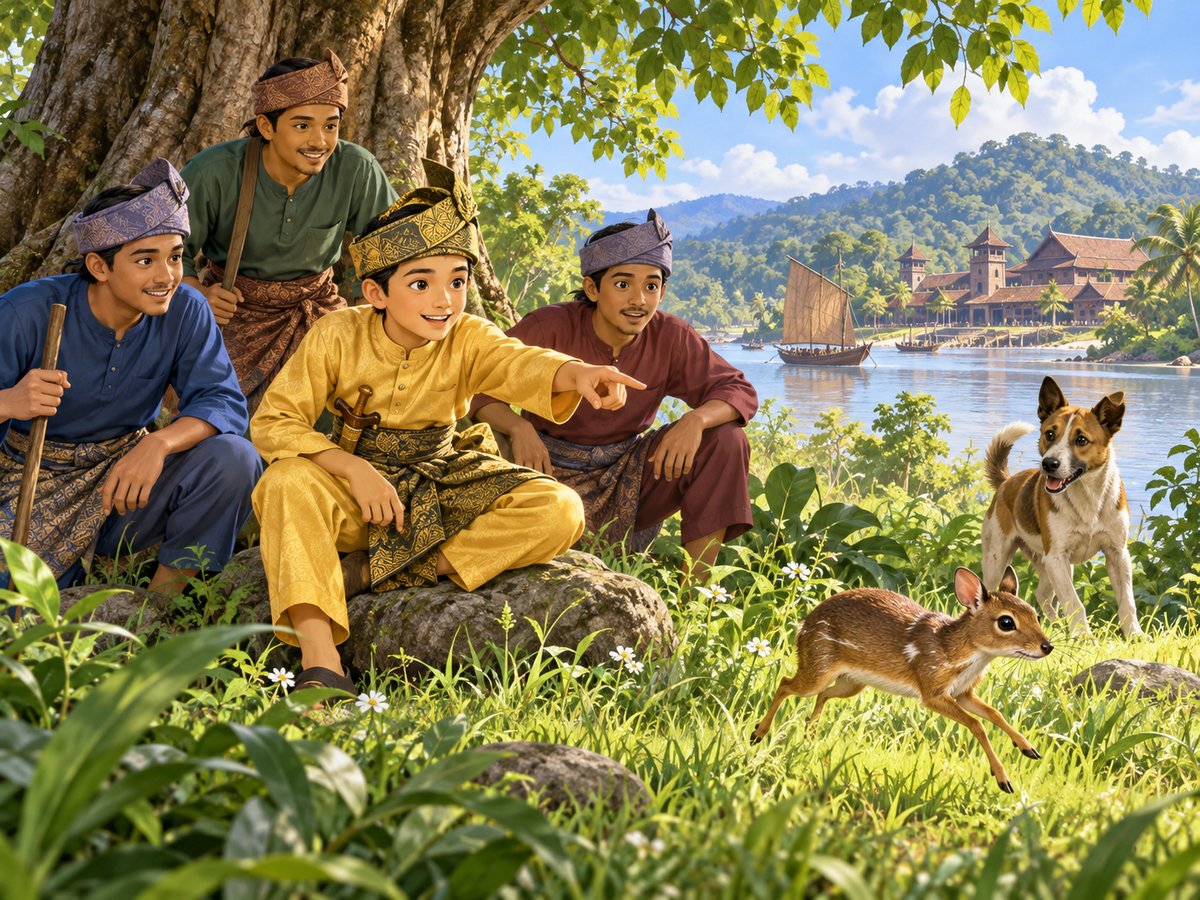
Seorang putera dari Palembang mengembara mencari tempat baharu untuk membina kerajaan. Akhirnya, beliau tiba di sebuah perkampungan nelayan di tepi sungai. Beliaulah Parameswara, pengasas Melaka.
the founder = pengasas
Parameswara was the founder of the Melaka Sultanate. This unit covers the records that mention him, his background, his journey, how Melaka was opened, where its name came from and why it became a great port.
Example: this prince from Palembang searched for a new place and finally reached a fishing village by a river.
Watch out: different records may describe the founder a little differently.
Kenali
Sumber tentang pengasas Melaka
Kisah pengasas Melaka dicatat dalam dua sumber bertulis yang terkenal:
Sulalatus Salatin – sumber tempatan (Tun Seri Lanang)
Suma Oriental – sumber Portugis (Tomé Pires)
Contoh: Sulalatus Salatin menyebut pengasas Melaka sebagai Sultan Iskandar Shah, manakala Suma Oriental menamakannya Parameswara.
记载开创者的文献 = sumber tentang pengasas
有两部著名的书记载马六甲的开创者:《马来纪年》(Sulalatus Salatin),是本地的马来文献,由敦斯里拉囊(Tun Seri Lanang)编写;《东方志》(Suma Oriental),是葡萄牙人皮列士(Tomé Pires)写的。两部书对开创者的名字说法不同。
例子:《马来纪年》称他为伊斯干达沙(Sultan Iskandar Shah),《东方志》称他为拜里米苏拉。
注意:比较不同的资料,是学历史的重要方法。
records of the founder = sumber tentang pengasas
Two famous books record Melaka's founder: Sulalatus Salatin, a local Malay text compiled by Tun Seri Lanang; and Suma Oriental, written by the Portuguese writer Tomé Pires. They give different names for the founder.
Example: Sulalatus Salatin calls him Sultan Iskandar Shah, while Suma Oriental names him Parameswara.
Watch out: comparing different sources is an important way to study history.
Semak kefahaman
Sumber manakah ditulis oleh orang Portugis?
分辨文献 = bezakan sumber
两部书中,一部是本地马来文献,一部是外国人写的。想一想皮列士是哪里人,他写的是哪一部。
例子:外国旅行者写的游记,可以让我们知道外国人怎么看马六甲。
注意:《汉都亚传》是另一部马来文学作品。
telling sources apart = bezakan sumber
Of the two books, one is a local Malay text and one was written by a foreigner. Think where Tomé Pires came from and which book he wrote.
Example: travel accounts by foreign visitors show how outsiders saw Melaka.
Watch out: Hikayat Hang Tuah is a different Malay literary work.
Fahami
Pengembaraan Parameswara
Parameswara ialah putera raja dari Palembang. Selepas Palembang diserang oleh Majapahit, beliau berundur dan mengembara:
Palembang → Temasik → Muar → Sening Ujong → Melaka
Contoh: Di setiap tempat, Parameswara berhadapan dengan ancaman sehingga beliau terus mencari tempat yang lebih selamat.
Parameswara's journey = pengembaraan Parameswara
Parameswara was a prince of Palembang. After Palembang was attacked by Majapahit, he withdrew and travelled: Palembang → Temasik (today's Singapore) → Muar → Sening Ujong → Melaka. He faced threats at each place, so he kept looking for somewhere safer.
Example: after being attacked in Temasik, he moved north to Muar.
Watch out: remember the order of the places.
Semak kefahaman
Ke manakah Parameswara pergi selepas meninggalkan Palembang?
order of the route = urutan laluan
The route is Palembang → Temasik → Muar → Sening Ujong → Melaka. The question asks for the first stop after Palembang.
Example: on a bus trip, the first stop is the one right after the start.
Watch out: Melaka is the destination, not the first stop.
Fahami
Peristiwa pembukaan Melaka
Ketika Parameswara berburu di tepi Sungai Bertam, anjing perburuannya ditendang oleh seekor pelanduk putih. Baginda menganggap tempat itu bertuah lalu membuka negeri di situ.
Contoh: Parameswara sedang berehat di bawah sebatang pokok. Pokok itu ialah pokok Melaka, lalu negeri baharu itu dinamakan Melaka.
开埠故事 = peristiwa pembukaan Melaka
拜里米苏拉在 Bertam 河边打猎时,他的猎狗被一只白色鼷鹿(pelanduk putih)踢下水。他觉得连小鼷鹿都这么勇敢,这个地方一定很吉祥,于是在这里建国。当时他正在一棵树下休息,那棵树叫马六甲树(pokok Melaka),新国家就叫马六甲。时间大约在 1400 年。
例子:小小的鼷鹿竟然敢踢猎狗,让王子觉得这地方不平凡。
注意:这是《马来纪年》记载的故事。
the founding of Melaka = peristiwa pembukaan Melaka
While Parameswara was hunting by the Bertam River, his hunting dog was kicked by a white mouse deer (pelanduk putih). He felt a place where even a tiny mouse deer was so brave must be lucky, so he founded his kingdom there. He was resting under a tree called the Melaka tree (pokok Melaka), so the new state was named Melaka, around the year 1400.
Example: a little mouse deer daring to kick a hunting dog made the prince feel the place was special.
Watch out: this is the story told in Sulalatus Salatin.
Semak kefahaman
Mengapakah Parameswara memilih tempat itu untuk membuka negeri?
选择地点的原因 = sebab memilih tempat
回想开埠故事:王子看到了什么不寻常的事,让他觉得这里很吉祥?
例子:故事里的主角是一只小小的鼷鹿。
注意:当时那里只是渔村,并没有宫殿。
why that place = sebab memilih tempat
Recall the founding story: what unusual thing did the prince see that made him feel the place was lucky?
Example: the hero of the story is a tiny mouse deer.
Watch out: at that time it was only a fishing village with no palace.
Fahami
Asal usul nama Melaka
Nama Melaka dihuraikan oleh pelbagai sumber:
Tempatan – pokok Melaka
Arab – Malakat (perhimpunan pedagang)
India – Amalaka
Barat (Portugis) – Malaqa
Contoh: Pedagang Arab menyebut “Malakat”, yang bermaksud tempat perhimpunan pedagang, kerana ramai pedagang berkumpul di Melaka.
马六甲名字的由来 = asal usul nama Melaka
关于马六甲名字有不同的说法:本地说法——来自拜里米苏拉休息时的马六甲树;阿拉伯说法——“Malakat”,意思是商人聚集的地方;印度说法——“Amalaka”,一种树或果实的名字;西方(葡萄牙)说法——写成“Malaqa”。
例子:阿拉伯商人称马六甲为“Malakat”,因为很多商人聚集在这里。
注意:四种说法来自四个不同的来源,要配对清楚。
origins of the name Melaka = asal usul nama Melaka
Sources explain the name differently: local, from the Melaka tree Parameswara rested under; Arab, 'Malakat', meaning a gathering place of traders; Indian, 'Amalaka', the name of a tree or fruit; and Western (Portuguese), written as 'Malaqa'.
Example: Arab traders called it 'Malakat' because so many merchants gathered there.
Watch out: the four explanations come from four different sources; match them carefully.
Padankan
Padankan sumber dengan sebutan nama Melaka
配对名字由来 = padankan asal usul nama
本地说法跟树有关;阿拉伯说法是 Malakat;印度说法是 Amalaka;西方说法是 Malaqa。一个一个配。
例子:葡萄牙人用自己的拼法记录地名。
注意:Malakat 和 Malaqa 很像,要看清楚。
matching name origins = padankan asal usul nama
The local version is about the tree; the Arab is Malakat; the Indian is Amalaka; the Western is Malaqa. Match them one by one.
Example: the Portuguese recorded place names in their own spelling.
Watch out: Malakat and Malaqa look alike, so read carefully.
Fikir
Keistimewaan Melaka
Melaka cepat maju sebagai pelabuhan kerana:
terletak di Selat Melaka yang strategik
terlindung daripada tiupan angin monsun
tempat pertemuan angin monsun timur laut dan barat daya
kebijaksanaan pentadbiran Parameswara
Contoh: Kapal dari timur dan barat singgah di Melaka sambil menunggu tiupan angin monsun yang sesuai untuk meneruskan pelayaran.
马六甲的优势 = keistimewaan Melaka
马六甲能很快成为大港口,是因为:位于马六甲海峡,地点有战略价值(kedudukan strategik);受到地形保护,不受季候风(angin monsun)直接吹袭,船只可以安全停泊;是东北季候风和西南季候风交会的地方,商船在这里等风;还有拜里米苏拉治理有方,吸引了各国商人。
例子:东西方的船只停在马六甲,等适合的季候风再继续航行。
注意:地理条件好,加上领导有智慧,两者都重要。
Melaka's advantages = keistimewaan Melaka
Melaka quickly became a great port because it lay on the Strait of Melaka, a strategic location (kedudukan strategik); it was sheltered from the full force of the monsoon winds (angin monsun), so ships could anchor safely; it was where the north-east and south-west monsoons met, so traders waited there for the wind; and Parameswara governed wisely, attracting traders from many lands.
Example: ships from east and west stopped at Melaka to wait for a suitable monsoon before sailing on.
Watch out: both good geography and wise leadership mattered.
why ships stayed = mengapa singgah
Sailing ships of old needed the right wind to set off, and Melaka was where two monsoons met. Think: what did the traders wait for there?
Example: you also wait for wind before flying a kite.
Watch out: Melaka was a great port, so of course it had a harbour.
Cinta akan Negara
Taat kepada pemimpin
Kejayaan Melaka bermula dengan pemimpin yang berani dan bijaksana serta rakyat yang taat setia. Kita menghormati institusi raja dan pemimpin negara.
Contoh: Seperti rakyat Melaka yang bersatu di bawah sultan, rakyat Malaysia hari ini perlu bersatu demi kemajuan negara.
效忠领袖 = taat kepada pemimpin
马六甲的成功,开始于勇敢、有智慧的领袖和忠心(taat setia)的人民。我们也要尊重王室和国家领袖,大家团结,国家才会进步。
例子:马六甲人民在苏丹领导下团结;今天马来西亚人民也要团结。
注意:尊重领袖,也包括遵守国家的法律和规则。
loyalty to leaders = taat kepada pemimpin
Melaka's success began with a brave, wise leader and loyal (taat setia) people. We too respect the monarchy and national leaders, and unity helps the country progress.
Example: Melaka's people united under the sultan; Malaysians today must unite too.
Watch out: respecting leaders also means obeying the country's laws and rules.
Fikir
Apakah iktibar daripada kisah Parameswara?
从故事学习 = iktibar daripada kisah
拜里米苏拉一次次遇到威胁,却一直寻找新的地方,最后建立了马六甲。想一想他表现了什么态度。
例子:考试没考好,继续努力,下次就有机会进步。
注意:轻易放弃跟他的经历正好相反。
learning from the story = iktibar daripada kisah
Parameswara faced threats again and again but kept searching and finally founded Melaka. Think about the attitude he showed.
Example: if a test goes badly, keep working and you can improve next time.
Watch out: giving up easily is the opposite of his story.
Ringkasan
Syabas!
Pengasas Melaka
Parameswara dari Palembang mengembara ke Temasik, Muar dan Sening Ujong sebelum membuka Melaka. Kisahnya dicatat dalam Sulalatus Salatin dan Suma Oriental. Melaka maju kerana kedudukan strategik dan kepimpinan yang bijaksana.