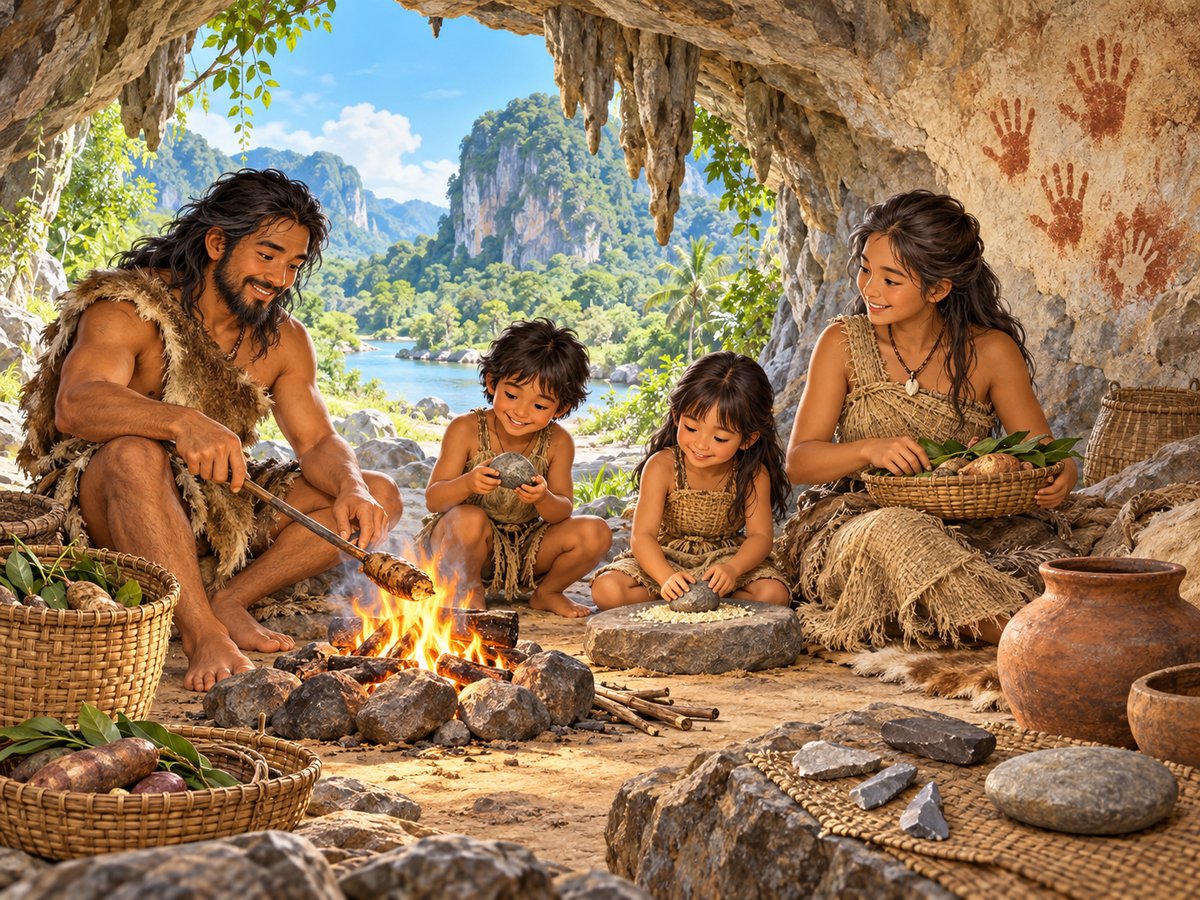
Ahli arkeologi menggali sebuah gua di Lenggong, Perak. Mereka menemui alat batu yang digunakan oleh manusia beribu-ribu tahun dahulu. Pada masa itu, manusia belum mengenal tulisan.
Zaman Prasejarah = 史前时代
史前时代是人类还没有文字记录以前的时代。因为没有文字,我们要靠考古挖掘出来的工具、陶器、骨头来认识当时的生活。这个单元学习史前时代的四个阶段、马来西亚的史前遗址、当时人类的生活和科技发展。
例子:考古学家在霹雳州玲珑的洞穴里挖出几千年前的石器。
注意:史前不是“没有人类”,而是“还没有文字”。
the Prehistoric Age = Zaman Prasejarah
The Prehistoric Age is the time before humans had writing. With no written records, we learn about life then from tools, pottery and bones found by archaeologists. This unit covers the four stages of prehistory, prehistoric sites in Malaysia, how people lived and how technology developed.
Example: archaeologists dig up stone tools thousands of years old in a cave at Lenggong, Perak.
Watch out: 'prehistoric' does not mean there were no people; it means there was no writing yet.
Kenali
Empat tahap Zaman Prasejarah
Zaman Prasejarah dibahagikan kepada empat tahap mengikut alat yang digunakan:
Paleolitik (200 000 SM) – kapak genggam
Mesolitik (14 000 SM) – alat batu lebih halus
Neolitik (3000 SM) – kapak batu digilap, tembikar
Zaman Logam (700 SM) – kapak bersoket, gendang gangsa
Contoh: Kapak genggam dibuat dengan memecahkan batu sehingga tajam. Kapak batu Zaman Neolitik pula telah digilap sehingga licin.
史前四个阶段 = empat tahap
史前时代按人类用的工具分成四个阶段:旧石器时代(Paleolitik)用打制的粗糙石器,例如手斧(kapak genggam);中石器时代(Mesolitik)石器比较精细;新石器时代(Neolitik)用磨光的石斧,也开始做陶器(tembikar);金属时代(Zaman Logam)用青铜和铁,例如有銎斧(kapak bersoket)和铜鼓(gendang gangsa)。
例子:手斧是把石头敲到锋利;新石器时代的石斧磨得很光滑。
按课本的时间线,四个阶段大约从公元前 200 000 年、14 000 年、3000 年和 700 年开始。
注意:四个阶段的次序是旧、中、新石器,最后金属。
four stages of prehistory = empat tahap
Prehistory is divided into four stages by the tools used: the Palaeolithic (Paleolitik) with rough chipped stone tools like the hand axe (kapak genggam); the Mesolithic (Mesolitik) with finer stone tools; the Neolithic (Neolitik) with polished stone axes and the first pottery (tembikar); and the Metal Age (Zaman Logam) with bronze and iron, such as socketed axes (kapak bersoket) and bronze drums (gendang gangsa).
Example: a hand axe was made by chipping stone until sharp; a Neolithic stone axe was polished smooth.
On the timeline they begin around 200 000 SM, 14 000 SM, 3000 SM and 700 SM.
Watch out: the order is Palaeolithic, Mesolithic, Neolithic and finally the Metal Age.
Semak kefahaman
Susunan manakah betul mengikut kronologi?
按时间排列 = susun ikut kronologi
“Paleo”是旧,“Meso”是中,“Neo”是新,最后人类才学会用金属。按从古到今的次序排。
例子:先学会用粗石头,后来才把石头磨光,再后来才会熔炼金属。
注意:有一个选项从金属时代倒着排回旧石器时代,那是倒过来的次序。
ordering by time = susun ikut kronologi
'Paleo' means old, 'Meso' middle and 'Neo' new, and people learned to use metal last. Arrange them from oldest to newest.
Example: people used rough stones first, later polished them, and only then learned to work metal.
Watch out: one option runs backwards from the Metal Age to the Palaeolithic; that order is reversed.
Padankan
Padankan zaman dengan alat atau artifaknya
配对时代与器物 = padankan zaman dan artifak
旧石器时代用粗糙的手斧;新石器时代有磨光石斧和陶器;金属时代有铜鼓。先看器物是石头、陶土还是金属,再配对。
例子:用青铜做的东西,一定属于金属时代。
注意:陶器是新石器时代才出现的。
matching ages and artefacts = padankan zaman dan artifak
The Palaeolithic used rough hand axes; the Neolithic had polished stone axes and pottery; the Metal Age had bronze drums. Check whether the item is stone, clay or metal, then match.
Example: anything made of bronze belongs to the Metal Age.
Watch out: pottery first appeared in the Neolithic.
Fahami
Tapak prasejarah di negara kita
Tinggalan prasejarah ditemui di seluruh Malaysia:
Bukit Jawa, Lenggong (Perak)
Gua Cha (Kelantan) · Gua Bewah (Terengganu)
Gua Niah, Miri (Sarawak)
Bukit Tengkorak, Semporna (Sabah)
Kampung Sungai Lang, Banting (Selangor)
Contoh: Gendang gangsa ditemui di Kampung Sungai Lang, Banting, Selangor, menunjukkan masyarakat Zaman Logam sudah mahir membuat barang logam.
我国的史前遗址 = tapak prasejarah di negara kita
马来西亚各地都发现了史前遗迹:霹雳州玲珑的武吉爪哇(Bukit Jawa, Lenggong)发现旧石器;吉兰丹的查洞(Gua Cha)和登嘉楼的 Gua Bewah 都有史前人类的遗迹;砂拉越美里的尼亚洞(Gua Niah)发现古人类头骨;沙巴仙本那的骷髅山(Bukit Tengkorak)发现大量陶器;雪兰莪万津的双溪浪村(Kampung Sungai Lang)发现铜鼓。
例子:双溪浪村出土的铜鼓,证明金属时代的人已经会做金属器物。
注意:沙巴、砂拉越也有重要的史前遗址,不只在半岛。
prehistoric sites in Malaysia = tapak prasejarah di negara kita
Prehistoric remains have been found all over Malaysia: Palaeolithic tools at Bukit Jawa, Lenggong (Perak); traces of early people at Gua Cha (Kelantan) and Gua Bewah (Terengganu); an ancient human skull at Gua Niah, Miri (Sarawak); lots of pottery at Bukit Tengkorak, Semporna (Sabah); and bronze drums at Kampung Sungai Lang, Banting (Selangor).
Example: the bronze drums from Kampung Sungai Lang show that Metal Age people could make metal objects.
Watch out: Sabah and Sarawak also have important prehistoric sites, not only the Peninsula.
Semak kefahaman
Tapak prasejarah manakah terletak di Sabah?
认识地点 = kenali lokasi
先看每个地名在哪一州:仙本那、美里、吉兰丹各属于哪里?题目只问沙巴。
例子:仙本那是沙巴东海岸的城镇。
注意:美里在砂拉越,不在沙巴。
knowing locations = kenali lokasi
First check which state each place is in: Semporna, Miri and Kelantan. The question asks only about Sabah.
Example: Semporna is a town on Sabah's east coast.
Watch out: Miri is in Sarawak, not Sabah.
Fahami
Kehidupan manusia prasejarah
Pada awalnya manusia hidup secara nomad (berpindah-randah) dan memburu binatang. Lama-kelamaan mereka tinggal tetap di lembah sungai, bercucuk tanam dan menternak.
Contoh: Masyarakat yang tinggal tetap mula menjalankan tukar barang, contohnya menukar tembikar dengan ikan kering.
史前人类的生活 = kehidupan manusia prasejarah
最早的人类过着游牧(nomad)生活,到处打猎、采集果实;后来他们在河谷(lembah sungai)定居,开始种植和饲养动物。定居以后,社会更有组织,有了领袖,也出现了分工(pengkhususan kerja),例如有人专门做陶器;人们用以物易物(tukar barang)交换东西。
例子:定居的群体用陶器换干鱼。
注意:以物易物时还没有钱币,是用东西换东西。
how prehistoric people lived = kehidupan manusia prasejarah
The earliest people lived as nomads (nomad), moving around to hunt and gather fruit. Later they settled in river valleys (lembah sungai) and began farming and raising animals. Settled societies became more organised, with leaders and specialised work (pengkhususan kerja), such as people who made only pottery; people exchanged goods by barter (tukar barang).
Example: a settled group trades pottery for dried fish.
Watch out: barter had no money yet; goods were exchanged for goods.
Semak kefahaman
Mengapakah manusia prasejarah memilih untuk tinggal di lembah sungai?
为什么住在河谷 = mengapa lembah sungai
种植和生活最需要什么?河边能提供什么?想一想水和土地。
例子:今天很多大城市也建在河边。
注意:史前时代还没有钱币。
why river valleys = mengapa lembah sungai
What do farming and daily life need most, and what does a river provide? Think about water and land.
Example: many big cities today are also built beside rivers.
Watch out: there was no money in prehistoric times.
Fikir
Sumbangan teknologi dahulu dan kini
Alat ciptaan manusia prasejarah menjadi asas kepada teknologi moden:
Pertanian: kapak batu → jentera
Pengangkutan: perahu → kapal
Dapur: tembikar dan kayu api → dapur elektrik
Contoh: Daripada kapak batu untuk memotong, kini kita menggunakan jentera. Daripada perahu kayu, kini ada kapal besar.
科技的演变 = teknologi dahulu dan kini
史前人类发明的简单工具,是今天科技的基础:农业从石斧到农业机械(jentera);交通从木舟(perahu)到大轮船(kapal);通讯从敲鼓、生火到现代通讯器材;厨房从陶锅、柴火到电炉(dapur elektrik)。
例子:以前用石斧砍东西,现在用机器;以前坐木舟,现在有大船。
注意:没有古人的发明,就没有今天的进步。
technology then and now = teknologi dahulu dan kini
The simple tools invented by prehistoric people are the basis of today's technology: farming went from stone axes to machinery (jentera); transport from wooden boats (perahu) to large ships (kapal); communication from drums and fire to modern devices; and kitchens from clay pots and firewood to electric stoves (dapur elektrik).
Example: people once cut things with stone axes and now use machines; they once paddled canoes and now have big ships.
Watch out: without ancient inventions, there would be no progress today.
Semak kefahaman
Alat moden manakah berkembang daripada perahu zaman dahulu?
找出演变 = cari perkembangan
木舟是在水上用的交通工具。今天在水上运送人和货物的,是什么?
例子:从牛车发展到汽车,也是交通工具的演变。
注意:电炉属于厨房用具,手机属于通讯工具。
tracing development = cari perkembangan
A wooden boat is transport on water. What carries people and goods on water today?
Example: the move from bullock carts to cars is also a change in transport.
Watch out: an electric stove is a kitchen tool and a smartphone is a communication tool.
Cinta akan Negara
Kreatif seperti manusia prasejarah
Manusia prasejarah kreatif dan inovatif walaupun hidup serba sederhana. Kita juga boleh berfikir kreatif untuk memajukan diri, masyarakat dan negara.
Contoh: Murid Tahun 4 mencipta kereta mainan mesra alam daripada botol plastik terpakai.
向古人学创意 = kreatif seperti manusia prasejarah
史前人类生活简单,却很有创意(kreatif)和创新精神(inovatif),能用石头、泥土做出工具。我们也可以学习他们,用创意解决问题,推动自己、社会和国家进步。
例子:四年级学生用旧塑料瓶做出环保玩具车。
注意:创意也包括把旧东西重新利用。
creative like prehistoric people = kreatif seperti manusia prasejarah
Prehistoric people lived simply but were creative (kreatif) and innovative (inovatif), making tools from stone and clay. We can follow their example and use creativity to solve problems and help ourselves, society and the nation progress.
Example: Year 4 pupils build an eco-friendly toy car from used plastic bottles.
Watch out: creativity also includes reusing old things in new ways.
Fikir
Apakah iktibar daripada kehidupan manusia prasejarah?
lessons from prehistory = iktibar
Prehistoric people made tools from the stone, clay and wood around them. Think: what attitude does this show is important?
Example: making a bookshelf from recycled boxes.
Watch out: creativity comes from always learning and trying.
Ringkasan
Syabas!
Zaman Prasejarah
Zaman Prasejarah ialah zaman sebelum tulisan: Paleolitik, Mesolitik, Neolitik dan Zaman Logam. Tinggalannya ditemui di Lenggong, Gua Cha, Gua Niah, Bukit Tengkorak dan Kampung Sungai Lang. Manusia beralih daripada hidup nomad kepada tinggal tetap.