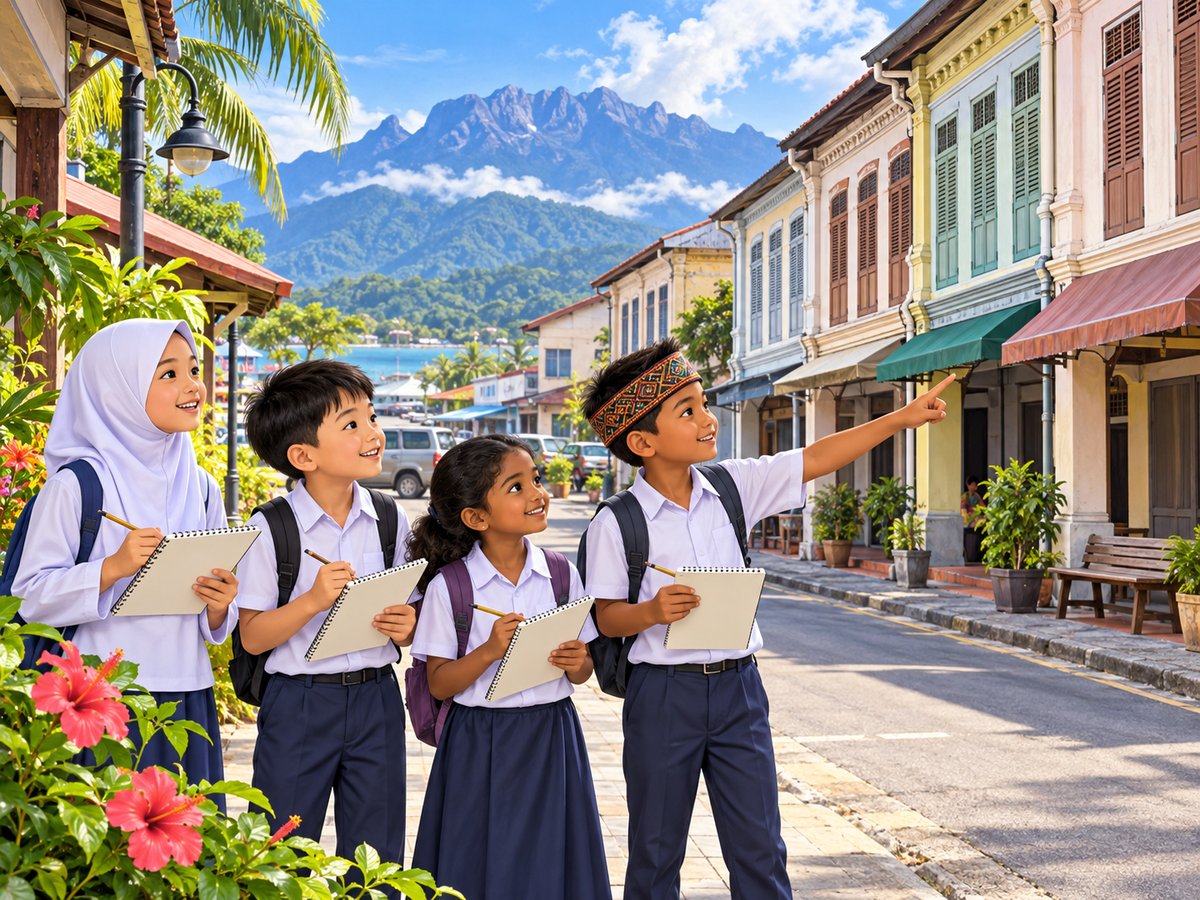
Aqilah tinggal di sebuah kampung di tepi Sungai Kinabatangan. Datuknya bercerita bagaimana kampung itu dibuka lebih 80 tahun dahulu. Tempat tinggal kita juga mempunyai sejarah.
sejarah tempat tinggal = 居住地的历史
我们住的地方也有历史:名字怎样来、发生过什么重要的事、有哪些为地方做出贡献的人物。这个单元学习住址和设施、地形和居民的经济活动、地名由来,以及地方人物。
例子:阿琪拉住在京那巴丹岸河边的村子,爷爷说这个村子 80 多年前开辟。
注意:长辈的口述也是认识地方历史的好来源。
history of where we live = sejarah tempat tinggal
The place we live in also has a history: how it got its name, what important events happened and who contributed to it. This unit covers addresses and facilities, landforms and local economic activities, origins of place names and local figures.
Example: Aqilah lives in a village by the Kinabatangan River; her grandfather says it was opened over 80 years ago.
Watch out: elders' spoken accounts are a good source of local history.
Kenali
Alamat dan kemudahan
Alamat lengkap mengandungi nombor rumah, nama jalan atau kampung, poskod, nama bandar dan nama negeri. Di sekitar tempat tinggal terdapat kemudahan seperti klinik, sekolah dan balai polis.
Contoh: No. 12, Kampung Batu Putih, 90200 Kinabatangan, Sabah. Berhampiran rumah Aqilah ada sebuah klinik desa dan dewan orang ramai.
地址和设施 = alamat dan kemudahan
完整的地址包括门牌号码、路名或村名、邮区编号、城镇名和州名。居住地附近还有各种设施(kemudahan),例如诊所、学校、警察局、礼堂,方便居民生活。
例子:阿琪拉家附近有乡村诊所和民众会堂。
注意:地址少了邮区编号,信件可能送不到。
address and facilities = alamat dan kemudahan
A full address includes the house number, street or village name, postcode, town and state. Around where we live there are facilities (kemudahan) such as clinics, schools, police stations and halls that make life easier.
Example: near Aqilah's house there is a village clinic and a community hall.
Watch out: without the postcode, a letter may not arrive.
Semak kefahaman
Maklumat manakah tidak perlu ditulis dalam alamat rumah?
找出不必写的 = cari yang tidak perlu
题目问“不需要写”的资料。想一想:邮差送信需要知道什么?哪一项对找到房子没有帮助?
例子:写信给奶奶时,要写门牌、村名、邮区编号、城镇和州名。
注意:题目里有 tidak,要选不必要的那一项。
finding what is not needed = cari yang tidak perlu
The question asks what does NOT need to be written. Think: what does the postman need to know, and which item does not help find the house?
Example: when writing to Grandma, include the house number, village, postcode, town and state.
Watch out: the question has 'tidak', so pick the unnecessary item.
Fahami
Bentuk muka bumi dan kegiatan ekonomi
Kegiatan ekonomi penduduk berkait dengan bentuk muka bumi tempat tinggal mereka:
Tanah tinggi – sayur-sayuran, bunga, pelancongan
Tanah pamah – padi, bandar
Pesisir laut – menangkap ikan, pelancongan pantai
Pinggir sungai – ikan sungai, pengangkutan air
Contoh: Penduduk di Kundasang (tanah tinggi) menanam sayur-sayuran, manakala penduduk di Semporna (pesisir laut) menjadi nelayan.
地形与经济 = bentuk muka bumi dan ekonomi
居民做什么工作,常常跟地形有关:高原(tanah tinggi)凉爽,适合种菜种花、发展旅游;平原(tanah pamah)适合种稻和建城市;海边(pesisir laut)居民多捕鱼、发展海滩旅游;河边(pinggir sungai)居民捕河鱼、用河道运输。
例子:昆达山在高原,居民种菜;仙本那在海边,居民当渔民。
注意:同一种地形,也可能有不只一种经济活动。
landforms and economy = bentuk muka bumi dan ekonomi
What people do for a living often depends on the landform: highlands (tanah tinggi) are cool, good for vegetables, flowers and tourism; lowlands (tanah pamah) suit rice farming and towns; coastal areas (pesisir laut) suit fishing and beach tourism; riverbanks (pinggir sungai) suit river fishing and transport by water.
Example: Kundasang is in the highlands, where people grow vegetables; Semporna is on the coast, where people fish.
Watch out: one landform may support more than one economic activity.
Padankan
Padankan bentuk muka bumi dengan kegiatan ekonomi yang sesuai
配对地形与经济 = padankan muka bumi dan ekonomi
想一想每种地形的特点:高原凉爽、海边靠海、平原平坦宽大、河边有河道。再找最适合的工作。
例子:沙巴的根地咬平原有很多稻田。
注意:一种地形配一项最合适的活动。
matching landforms and economy = padankan muka bumi dan ekonomi
Think about each landform: highlands are cool, the coast is by the sea, lowlands are flat and wide, riverbanks have waterways. Then find the most suitable work.
Example: the Keningau plain in Sabah has many paddy fields.
Watch out: match each landform with its best activity.
Fahami
Asal usul nama tempat
Banyak nama tempat mempunyai asal usul yang menarik, biasanya berkait dengan sungai, tumbuhan, peristiwa atau tokoh.
Johor Bahru – dahulu dikenali sebagai Tanjung Puteri
Ranau – berasal daripada perkataan Dusun “Ranahon”
Miri – berkembang selepas telaga minyak pertama digali pada tahun 1910
Contoh: Kuala Lumpur mendapat nama kerana terletak di kuala (pertemuan) Sungai Klang dan Sungai Gombak yang airnya berlumpur.
地名由来 = asal usul nama tempat
很多地名都有有趣的由来,通常跟河流、植物、事件或人物有关。认识地名由来,也是在认识地方的历史。
例子:吉隆坡(Kuala Lumpur)位于巴生河和鹅麦河的交汇处(kuala),河水多泥(lumpur),因此得名。新山(Johor Bahru)从前叫 Tanjung Puteri;沙巴的兰脑(Ranau)名字来自杜顺语“Ranahon”;砂拉越的美里(Miri)在 1910 年挖出第一口油井后发展起来。
注意:地名由来要从可靠的资料或长辈口中了解,不要自己乱编。
origins of place names = asal usul nama tempat
Many place names have interesting origins, usually linked to rivers, plants, events or people. Learning them is learning local history.
Example: Kuala Lumpur is at the meeting point (kuala) of the Klang and Gombak rivers, whose water is muddy (lumpur). Johor Bahru was once called Tanjung Puteri; Ranau in Sabah takes its name from the Dusun word 'Ranahon'; and Miri in Sarawak grew after its first oil well was dug in 1910.
Watch out: learn name origins from reliable sources or elders rather than making them up.
Semak kefahaman
Mengikut asal usulnya, perkataan “kuala” dalam Kuala Lumpur bermaksud apa?
理解地名 = fahami nama tempat
吉隆坡的由来跟两条河有关。kuala 指的是河流汇合或流入大海、大河的地方。
例子:瓜拉丁加奴(Kuala Terengganu)也在河口。
注意:lumpur 才是“泥”的意思。
understanding the name = fahami nama tempat
The origin of Kuala Lumpur involves two rivers. 'Kuala' means where rivers meet or flow into the sea or a bigger river.
Example: Kuala Terengganu also lies at a river mouth.
Watch out: 'lumpur' is the word that means mud.
Kenali
Tokoh setempat
Tokoh setempat ialah individu yang memberi sumbangan besar kepada masyarakat di sesuatu tempat, seperti guru, ketua kampung, malim gunung atau aktivis alam sekitar.
Contoh: Pak Kassim, seorang aktivis di kampung Aqilah, mengajak penduduk menjaga hutan paya bakau. Kini kampung itu terkenal dengan ekopelancongan.
地方人物 = tokoh setempat
地方人物是对某个地方的居民做出很大贡献的人,例如老师、村长、登山向导(malim gunung)、环保人士(aktivis)。他们的贡献可能是教育、保护环境、带动经济或帮助社区。
例子:环保人士卡欣伯伯带动村民保护红树林,现在村子以生态旅游出名。
注意:地方人物不一定很有名,但对当地很重要。
local figures = tokoh setempat
A local figure is someone who has contributed greatly to the people of a place, such as a teacher, village head, mountain guide (malim gunung) or environmental activist (aktivis). Their contribution may be in education, protecting nature, boosting the economy or helping the community.
Example: Pak Kassim, an activist in Aqilah's village, led villagers to protect the mangroves, and the village is now known for eco-tourism.
Watch out: a local figure may not be famous, but matters a lot to the area.
identifying the contribution = kenal pasti sumbangan
Recall what Pak Kassim did: what did he lead the villagers to do, and how did it benefit the village?
Example: a teacher who teaches village children to read for free is making a contribution.
Watch out: a contribution is something that benefits everyone.
Amalkan
Langkah kajian kes
Laporan kajian kes tentang tokoh setempat mengandungi bahagian berikut:
Pernyataan masalah · Objektif kajian
Kaedah kajian · Analisis data
Hasil dapatan · Rujukan · Lampiran
Contoh: Aqilah menulis objektif kajian: “Mengetahui sumbangan Pak Kassim kepada kampung saya.” Kemudian dia menemu bual Pak Kassim.
steps of a case study = langkah kajian kes
A case study report on a local figure has these parts: problem statement (pernyataan masalah), objective (objektif kajian), research method (kaedah kajian, such as interviews or reading), data analysis (analisis data), findings (hasil dapatan), references (rujukan) and appendices (lampiran).
Example: Aqilah first writes her objective, 'to find out Pak Kassim's contributions to my village', then interviews him.
Watch out: make an appointment before an interview and politely explain its purpose.
Semak kefahaman
Bahagian manakah menerangkan cara maklumat dikumpul, seperti temu bual?
报告的部分 = bahagian laporan
题目问的是说明“怎样收集资料”的那一部分。目的是说“为什么做研究”,附录是放照片、问卷等补充材料,都不是在说方法。
例子:写明“我访问了村长和两位老村民”,就是在说明研究方法。
注意:kaedah 就是“方法”的意思。
parts of the report = bahagian laporan
The question asks which part explains how information was collected. The objective says why the study was done, and the appendix holds extra material such as photos and questionnaires; neither describes the method.
Example: writing 'I interviewed the village head and two older villagers' explains the research method.
Watch out: 'kaedah' means method.
Cinta akan Negara
Menghargai tempat tinggal
Sebagai warganegara, kita menjaga kebersihan dan keindahan tempat tinggal supaya dapat dinikmati oleh generasi akan datang.
Contoh: Aqilah dan rakan-rakannya menyertai gotong-royong membersihkan tebing sungai.
爱护居住地 = menghargai tempat tinggal
作为国民(warganegara),我们要一起保持居住地干净、美丽,让下一代也能享受,这就是可持续(kelestarian)。爱护社区,也是爱国的表现。
例子:阿琪拉和朋友参加清理河岸的大扫除。
注意:保护环境需要大家合作,不是只靠政府。
valuing where we live = menghargai tempat tinggal
As citizens (warganegara), we keep our area clean and beautiful so future generations can enjoy it too; this is sustainability (kelestarian). Caring for the community is also a way of loving the country.
Example: Aqilah and her friends join a clean-up of the riverbank.
Watch out: protecting the environment needs everyone's cooperation, not only the government's.
Fikir
Tindakan manakah menunjukkan kita menghargai tempat tinggal?
爱护居住地的行为 = tindakan menghargai
想一想:哪一个做法让社区更干净、更美?哪些会弄脏或破坏环境?
例子:把垃圾分类回收。
注意:在公园摘花会破坏大家共享的环境。
caring actions = tindakan menghargai
Think: which action makes the community cleaner and more beautiful, and which ones dirty or damage it?
Example: sorting rubbish for recycling.
Watch out: picking flowers in a public park spoils a shared space.
Ringkasan
Syabas!
Sejarah tempat tinggal saya
Kenali alamat dan kemudahan, kaitkan bentuk muka bumi dengan kegiatan ekonomi, ketahui asal usul nama tempat dan hargai sumbangan tokoh setempat.