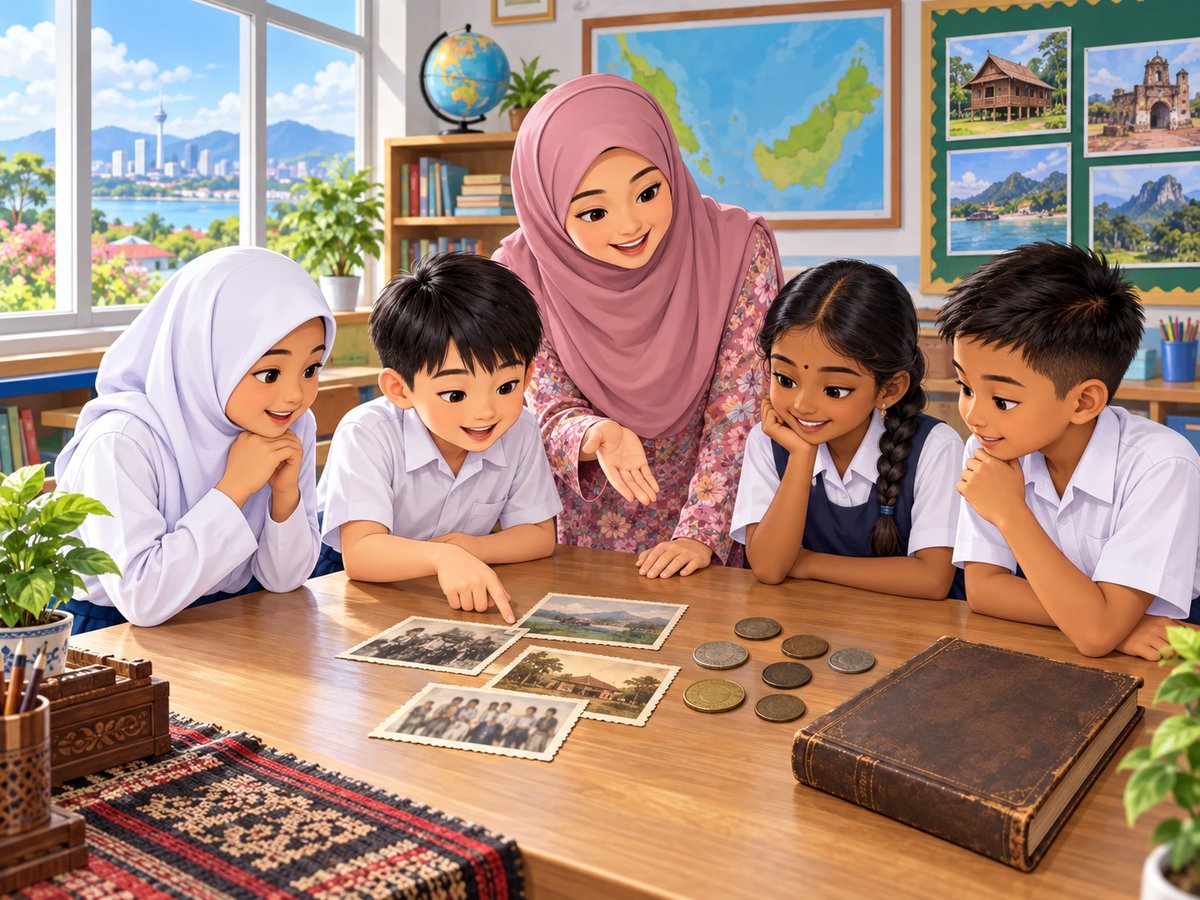
Datuk Faris menunjukkan sekeping gambar lama kepada cucunya. “Inilah rumah kampung kita pada tahun 1975,” katanya. Kisah tentang perkara yang berlaku pada masa lalu dipanggil sejarah.
sejarah = 历史
历史就是过去发生过的事,以及人们怎样研究、记录这些事。这个单元学习历史的意思、历史资料从哪里来、历史学家怎样研究,还有怎样排列时间、找出事情的原因和结果。
例子:爷爷拿出 1975 年老家的照片,照片里的故事就是家里的历史。
注意:历史讲的是真实发生过的事,不是凭空想象的故事。
history = sejarah
History is what happened in the past and how people study and record it. This unit covers the meaning of history, where historical sources come from, how historians research, how to order time and how to find causes and effects.
Example: Grandpa shows an old photo of the family home in 1975; the story behind it is part of the family's history.
Watch out: history is about things that really happened, not made-up stories.
Kenali
Apakah itu sejarah?
Sejarah ialah kajian tentang peristiwa yang benar-benar berlaku pada masa lalu. Daripada sejarah, kita mendapat iktibar dan teladan untuk kehidupan hari ini.
Contoh: Herodotus, ahli sejarah Yunani, dikenali sebagai “Bapa Sejarah” kerana mencatat peristiwa masa lalu dengan teliti.
历史的意思 = maksud sejarah
历史是研究过去真正发生过的事件。读历史可以得到教训(iktibar)和榜样(teladan),帮助我们今天做更好的决定,也让我们认识国家和祖先的文明(peradaban)。
例子:古希腊的希罗多德仔细记录过去的事,被称为“历史之父”。
注意:只是“很久以前”还不够,还要是真实发生、有证据的事。
the meaning of history = maksud sejarah
History is the study of events that really happened in the past. From history we gain lessons (iktibar) and role models (teladan) that help us make better choices today, and we learn about the civilisation (peradaban) of our country and ancestors.
Example: Herodotus of ancient Greece recorded past events carefully and is called the 'Father of History'.
Watch out: being 'long ago' is not enough; it must have really happened and have evidence.
Semak kefahaman
Apakah kebaikan mempelajari sejarah?
学历史的好处 = kebaikan belajar sejarah
想一想:过去的人做对了什么、做错了什么,对我们今天有什么帮助?学历史的好处跟“学到教训、找到榜样”有关。
例子:知道从前的大水灾,现在的人就懂得提早防范。
注意:历史不能预测运气,也不能代替其他科目。
why learn history = kebaikan belajar sejarah
Think: what did people in the past do right or wrong, and how does that help us today? The benefit is about learning lessons and finding role models.
Example: knowing about a great flood long ago helps people today prepare early.
Watch out: history cannot predict luck and does not replace other subjects.
Kenali
Pandangan tokoh sejarawan
Beberapa tokoh menghuraikan maksud sejarah:
Herodotus – Bapa Sejarah
Ibn Khaldun – sejarah tentang peradaban dan perubahan masyarakat
E.H. Carr – proses interaksi antara masa kini dengan masa lampau
Khoo Kay Kim – peristiwa yang telah berlaku
Muhd Yusof Ibrahim – rekod peristiwa masa lalu
历史学家的看法 = pandangan tokoh sejarawan
几位历史学家这样说明历史:希罗多德(Herodotus)被称为“历史之父”;伊本·赫勒敦(Ibn Khaldun)认为历史讲的是人类文明和社会的变化;卡尔(E.H. Carr)认为历史是现在和过去之间互动的过程(proses interaksi antara masa kini dengan masa lampau);本地学者邱家金教授(Khoo Kay Kim)指历史是已经发生的事;尤索夫·依布拉欣博士(Muhd Yusof Ibrahim)指历史是过去事件的记录。
例子:这五位学者说法不同,但都同意历史跟过去发生的事有关。
注意:两位本地学者的看法也要记住。
historians' views = pandangan tokoh sejarawan
Several historians explain history: Herodotus is called the 'Father of History'; Ibn Khaldun saw history as the story of human civilisation and how societies change; E.H. Carr saw it as a process of interaction between the present and the past (proses interaksi antara masa kini dengan masa lampau); the local scholar Prof. Khoo Kay Kim described it as events that have happened; and Dr. Muhd Yusof Ibrahim described it as the record of past events.
Example: the five scholars put it differently, but all agree history is about what happened in the past.
Watch out: remember the two local scholars' views as well.
Padankan
Padankan tokoh dengan pandangannya tentang sejarah
配对学者与看法 = padankan tokoh
先想:谁被称为“历史之父”?两位本地学者中,谁强调“已经发生的事”,谁强调“记录”?再一个个配对。
例子:伊本·赫勒敦的看法跟文明和社会变化有关。
注意:“发生的事”和“事件的记录”意思接近,要看清楚。
matching scholars and views = padankan tokoh
First think: who is called the 'Father of History'? Of the two local scholars, who stresses 'events that have happened' and who stresses 'records'? Then match one by one.
Example: Ibn Khaldun's view is about civilisation and social change.
Watch out: 'events that happened' and 'records of events' sound alike, so read carefully.
Fahami
Sumber primer dan sumber sekunder
Maklumat sejarah diperoleh daripada sumber.
Sumber primer – belum diolah: fosil, artifak, manuskrip, surat lama, gambar asal
Sumber sekunder – telah diolah dan diterbitkan: buku, majalah, ensiklopedia
Contoh: Surat yang ditulis oleh Datuk Faris pada tahun 1975 ialah sumber primer. Buku cerita sejarah kampung yang ditulis kemudian ialah sumber sekunder.
第一手和第二手资料 = sumber primer dan sekunder
第一手资料(sumber primer)是还没有被整理、改写的原始资料,例如化石(fosil)、文物(artifak)、手稿(manuskrip)、旧信件、旧照片。第二手资料(sumber sekunder)是别人根据原始资料整理写成的,例如历史书、杂志、百科全书。
例子:爷爷 1975 年写的信是第一手资料;后来出版的村史书是第二手资料。
注意:判断时问自己:这是当时留下来的,还是后来的人整理写成的?
primary and secondary sources = sumber primer dan sekunder
Primary sources are original materials not yet processed or rewritten, such as fossils (fosil), artefacts (artifak), manuscripts (manuskrip), old letters and photos. Secondary sources are written later by people using the originals, such as history books, magazines and encyclopaedias.
Example: Grandpa's 1975 letter is a primary source; a village history book published later is secondary.
Watch out: ask yourself whether it was left from that time or written up later by someone else.
Pilih semua
Pilih semua sumber primer.
找出第一手资料 = cari sumber primer
逐一想:这件东西是当年留下来的原物,还是后人写成、出版的书刊?化石、手稿、古陶器是原物;书本、百科全书、杂志都是后来整理的。这题有几个答案。
例子:博物馆里的古铜鼓是第一手资料。
注意:内容讲历史的书,不等于它就是第一手资料。
finding primary sources = cari sumber primer
Think about each: is it an original item left from that time, or a publication written later? Fossils, manuscripts and ancient pottery are originals; books, encyclopaedias and magazines are compiled later. There are several answers.
Example: an ancient bronze drum in a museum is a primary source.
Watch out: a book about history is not automatically a primary source.
Fahami
Kaedah penyelidikan sejarah
Ahli sejarah mengumpul maklumat dengan tiga kaedah:
Kaedah arkeologi – ekskavasi (menggali) untuk mencari artifak
Kaedah lisan – menemu bual orang sumber
Kaedah bertulis – membaca buku, dokumen dan rekod
Contoh: Untuk mengetahui sejarah kampungnya, Aina menemu bual Datuk Faris (kaedah lisan) dan membaca rekod lama di pejabat kampung (kaedah bertulis).
三种研究方法 = tiga kaedah penyelidikan
考古法(kaedah arkeologi):挖掘(ekskavasi)地下,找出文物和化石;口述法(kaedah lisan):访问知道往事的人(orang sumber);文字法(kaedah bertulis):阅读书本、档案、旧记录。
例子:艾娜访问爷爷是口述法,到村办公室看旧记录是文字法。
注意:访问前要先准备问题,也要有礼貌地征得对方同意。
three research methods = tiga kaedah penyelidikan
The archaeological method (kaedah arkeologi) digs up the ground (ekskavasi) to find artefacts and fossils; the oral method (kaedah lisan) interviews people who know about the past (orang sumber); the written method (kaedah bertulis) reads books, archives and old records.
Example: Aina interviewing her grandfather is the oral method; reading old records at the village office is the written method.
Watch out: prepare questions before an interview and politely ask for permission.
Padankan
Padankan situasi dengan kaedah penyelidikan
配对研究方法 = padankan kaedah
每个情况先问:资料是挖出来的、问出来的,还是读出来的?挖掘对应考古法,访问对应口述法,阅读对应文字法。
例子:翻看学校的旧纪念刊,是文字法。
注意:访问的对象叫 orang sumber,就是知道往事的人。
matching research methods = padankan kaedah
For each situation ask: was the information dug up, asked for or read? Digging is archaeology, interviewing is the oral method and reading is the written method.
Example: looking through an old school magazine is the written method.
Watch out: the person interviewed is called an 'orang sumber', someone who knows about the past.
Amalkan
Langkah kaedah lisan
Kaedah lisan dijalankan mengikut tiga langkah:
1. Kenal pasti orang sumber dan sediakan soalan
2. Jalankan temu bual dan rakam
3. Salin rakaman, simpan maklumat dan tulis laporan
Contoh: Aina menyediakan soalan, merakam temu bual dengan Datuk Faris, kemudian menyalin rakaman itu dan menulis laporan.
口述法的步骤 = langkah kaedah lisan
口述法有三个步骤:第一,确定要访问的人(orang sumber),准备好问题;第二,进行访问,并录音或做笔记;第三,把录音整理成文字、保存资料,再写成报告。
例子:艾娜先准备问题,访问爷爷并录音,最后把录音写成文字报告。
注意:录音之前要先征得受访者同意。
steps of the oral method = langkah kaedah lisan
The oral method has three steps: first, choose the person to interview (orang sumber) and prepare questions; second, carry out the interview and record it or take notes; third, transcribe the recording, keep the information safe and write a report.
Example: Aina prepares questions, records her interview with Grandpa, then writes up the recording as a report.
Watch out: ask the person's permission before recording.
Fahami
Ruang dan masa
Peristiwa sejarah disusun mengikut kronologi, iaitu susunan masa dari awal hingga akhir.
1 dekad = 10 tahun
1 abad = 100 tahun
1 alaf = 1 000 tahun
SM (Sebelum Masihi) – sebelum kelahiran Nabi Isa
M (Masihi) – selepas kelahiran Nabi Isa
Contoh: Tahun 2000 hingga 2009 ialah satu dekad. Tahun 1901 hingga 2000 ialah abad ke-20.
units of time = unit masa
Historical events are arranged in time order (kronologi). Common units: a dekad is 10 years, an abad (century) is 100 years and an alaf (millennium) is 1000 years. There are also Sebelum Masihi (SM), the time before the birth of Prophet Isa (Jesus), and Masihi (M), the time after his birth.
Example: 2000 to 2009 is one dekad; 1901 to 2000 is the 20th century.
Watch out: a bigger SM number is further from now, while a bigger M number is closer to now.
Semak kefahaman
Berapakah tahun dalam satu abad?
记住时间单位 = ingat unit masa
三个单位从小到大是 dekad、abad、alaf,分别是 10 年、100 年、1000 年。题目问的是中间那一个。
例子:从 1801 年到 1900 年是第 19 世纪,刚好一个 abad。
注意:不要把 abad 和 alaf 弄混,两个字开头都是 a。
remembering time units = ingat unit masa
From smallest to largest the units are dekad, abad and alaf: 10, 100 and 1000 years. The question asks about the middle one.
Example: 1801 to 1900 is the 19th century, exactly one abad.
Watch out: do not mix up abad and alaf, which both start with 'a'.
Semak kefahaman
Peristiwa manakah yang paling lama berlaku?
比较 SM 和 M = banding SM dan M
SM 是公元前,数字越大越久远;M 是公元,数字越大越接近现在。先找出有没有 SM,再比较数字。
例子:300 SM 比 50 SM 更早。
注意:200 M 虽然数字大,但它在公元以后,比所有 SM 都晚。
comparing SM and M = banding SM dan M
SM years count backwards, so a bigger number is longer ago; M years count forwards, so a bigger number is closer to now. Find the SM years first, then compare the numbers.
Example: 300 SM is earlier than 50 SM.
Watch out: 200 M has a big number but comes after year 1, so it is later than every SM year.
Fikir
Sebab dan akibat
Setiap peristiwa sejarah mempunyai sebab (punca) dan akibat (kesan). Mengkaji sebab dan akibat membantu kita mengambil iktibar.
Contoh: Sebab: rakyat mahu bebas daripada penjajahan British dan bersatu menuntut kemerdekaan. Akibat: Persekutuan Tanah Melayu mencapai kemerdekaan pada 31 Ogos 1957.
原因与结果 = sebab dan akibat
每件历史事件都有原因(sebab,为什么会发生)和结果(akibat,发生后带来什么影响)。找出因果关系,可以让我们记取教训,避免重犯同样的错误。
例子:原因是人民希望摆脱英国殖民统治,团结起来争取独立;结果是马来亚联合邦在 1957 年 8 月 31 日独立。
注意:先发生的通常是原因,后发生的是结果。
cause and effect = sebab dan akibat
Every historical event has a cause (sebab: why it happened) and an effect (akibat: what it led to). Finding the link helps us learn lessons and avoid repeating mistakes.
Example: the cause is that the people wanted freedom from British rule and united to demand independence; the effect is that the Federation of Malaya gained independence on 31 August 1957.
Watch out: what happens first is usually the cause, and what follows is the effect.
Semak kefahaman
Pak Hamid menebang semua pokok di tepi bukit. Apakah akibat yang mungkin berlaku?
推想结果 = jangka akibat
砍树是原因,题目要你想结果。树根本来能抓住泥土,树全部砍掉以后,下大雨时泥土会怎样?
例子:原因:天气太热又不下雨;结果:河水变浅。
注意:结果要跟原因有合理的关系。
predicting the effect = jangka akibat
Cutting the trees is the cause; you need to think of the effect. Tree roots hold the soil, so what happens to the soil in heavy rain once all the trees are gone?
Example: cause: very hot weather with no rain; effect: the river becomes shallow.
Watch out: the effect must be reasonably linked to the cause.
Cinta akan Negara
Memelihara warisan sejarah
Kita semua bertanggungjawab menjaga warisan sejarah: tidak merosakkan bangunan lama, menghargai artifak dan melawat muzium.
Contoh: Semasa lawatan ke muzium, Aina tidak menyentuh artifak dan mematuhi peraturan.
爱护历史遗产 = memelihara warisan sejarah
古建筑、文物和历史记录是国家的宝贵遗产。个人可以爱惜古迹、不乱涂乱画;社会可以一起参观博物馆、记录长辈的故事;国家会设立博物馆保护文物。
例子:参观博物馆时,艾娜不碰展品,也遵守规则。
注意:在古迹上刻名字或乱丢垃圾,会破坏遗产。
caring for heritage = memelihara warisan sejarah
Old buildings, artefacts and records are the nation's precious heritage. Individuals can respect historic sites and avoid graffiti; communities can visit museums and record elders' stories; the country sets up museums to protect artefacts.
Example: on a museum visit, Aina does not touch the exhibits and follows the rules.
Watch out: carving names on historic sites or littering there damages our heritage.
Fikir
Tindakan manakah menunjukkan sikap menghargai warisan sejarah?
valuing heritage = menghargai warisan
Think: which action keeps a historic site intact for the next generation, and which ones damage it?
Example: taking photos at an old fort without climbing its walls.
Watch out: taking even one brick from a historic site is damage.
Ringkasan
Syabas!
Mengenali sejarah
Sejarah ialah kajian peristiwa masa lalu. Maklumat diperoleh daripada sumber primer dan sekunder melalui kaedah arkeologi, lisan dan bertulis. Susun peristiwa mengikut kronologi dan kaji sebab serta akibatnya.