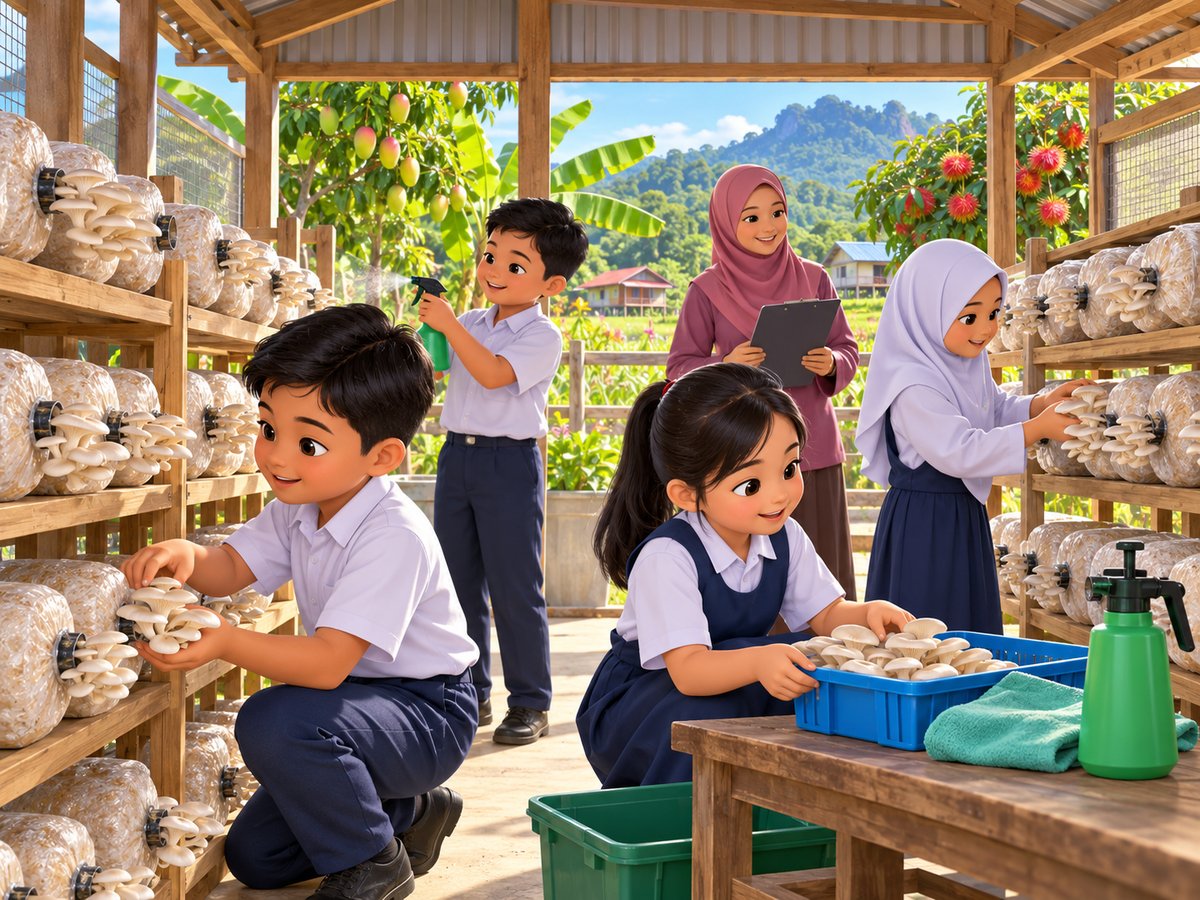
Kelab Pertanian sekolah menanam cendawan di dalam bongkah dan membuat baja daripada sisa dapur. Murid-murid mencatat setiap langkah dengan teliti. Mari bertani!
来种田吧 = mari bertani
这个单元以种植为主题:听种菇的简报、读制作植物促进剂的步骤、整理水果资料,以及复习四类形容词(方式、情感、时间、五官)。
例子:学校农业社用菇包种菇,用厨余做肥料。
注意:按步骤做事,结果才会好。
let's farm = mari bertani
This unit is about growing things: a briefing on growing mushrooms, steps for making a plant booster, organising fruit facts, and reviewing four types of adjectives (manner, feeling, time, senses).
Example: the school agriculture club grows mushrooms in blocks and makes fertiliser from kitchen scraps.
Watch out: follow the steps carefully for good results.
Membaca
Langkah membuat penggalak tumbuhan
Langkah: (1) Pecahkan sebiji telur ke dalam bekas. (2) Masukkan susu kultur dan kacau sehingga sebati. (3) Tutup bekas dan biarkan selama tiga hari. (4) Cairkan dengan air sebelum disiram pada tanaman.
Contoh: Gunakan penanda urutan: pertama, kedua, seterusnya, akhir sekali.
steps = langkah
Making a plant booster: crack an egg into a container → add cultured milk drink (susu kultur) and stir well → close and leave for three days → dilute with water before watering plants. Use pertama (first), kedua (second), seterusnya (next), akhir sekali (finally).
Example: first, crack the egg into the container; finally, dilute and water the plants.
Watch out: the order matters or it will not work.
Semak kefahaman
Apakah langkah selepas memasukkan susu kultur dan mengacau campuran itu?
the next step = langkah seterusnya
Step one is cracking the egg and step two is adding cultured milk and stirring. What is step three? Look back at step (3) on the last screen and notice how many days.
Example: when baking, you mix before putting it in the oven.
Watch out: cracking the egg is step one; watering without diluting is wrong.
Menulis
Mencatat fakta dalam peta grafik
Fakta penting tentang buah kuning telur dicatat mengikut kategori: rupa, rasa, khasiat dan cara makan.
Contoh: Rupa: kulit kuning; Rasa: manis dan lembut seperti kuning telur rebus; Khasiat: kaya vitamin.
整理资料 = peta grafik
把蛋黄果的资料按类别整理:外表、味道、营养、吃法。这样资料清楚,容易比较和记住。
例子:外表:黄色;味道:甜、软,像煮熟的蛋黄;营养:富含维生素。
注意:只写重点,不用抄整句。可以把重点抄进笔记本,旁边写一个自己想到的例子。
organising facts = peta grafik
Sort facts about the egg fruit (buah kuning telur) by category: appearance, taste, nutrition and how to eat it. This keeps information clear and easy to remember.
Example: appearance: yellow skin; taste: sweet and soft like boiled egg yolk; nutrition: rich in vitamins.
Watch out: write key points only, not whole sentences.
Contoh: Datuk memilih durian dengan cermat. Buahnya harum dan manis.
四类形容词 = empat jenis adjektif
方式形容词(cermat 小心、cepat 快)、情感形容词(gembira 开心、bimbang 担心)、时间形容词(awal 早、lewat 迟、lama 久)、五官形容词(manis 甜、harum 香、kasar 粗糙)。
例子:爷爷小心地挑榴梿,果肉又香又甜。
注意:先想它描述的是方式、感受、时间还是感官。平时读马来文报纸或故事书时,留意有没有用到这一点。
four adjective types = empat jenis adjektif
Manner (cermat careful, cepat fast); feeling (gembira happy, bimbang worried); time (awal early, lewat late, lama long); senses (manis sweet, harum fragrant, kasar rough).
Example: Grandpa chooses durians carefully; the flesh is fragrant and sweet.
Watch out: ask whether it describes manner, feeling, time or a sense.
matching adjectives = padankan
Bimbang (worried) is a feeling; lewat (late) is time; kasar (rough) is felt by touch, a sense adjective.
Example: masam (sour) is also a sense adjective.
Watch out: think about what each word describes.
Ringkasan
Syabas!
Mari bertani
Ikut langkah mengikut urutan. Catat fakta dalam peta grafik mengikut kategori. Kata adjektif terbahagi kepada cara, perasaan, waktu dan pancaindera.