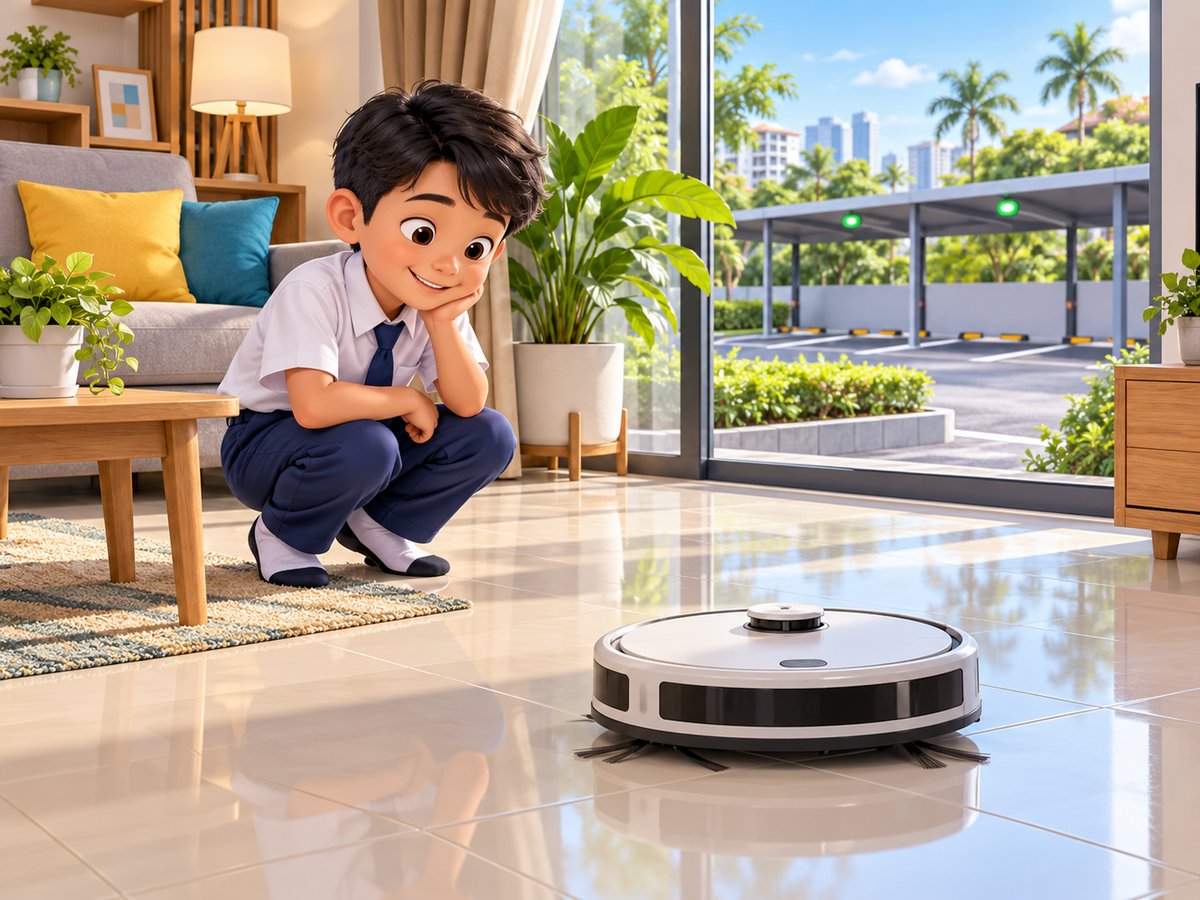
Di pusat beli-belah, lampu hijau di atas petak menunjukkan tempat letak kereta yang kosong. Di rumah, robot pembersih menyedut habuk sendiri. Teknologi memudahkan kehidupan kita.
生活中的科技 = teknologi dalam kehidupan
这个单元以科技为主题:讲解智能停车系统、朗诵关于手机的诗、修改对话里的错误、改编扫地机器人的故事,以及疑问句(ayat tanya)和主动句(ayat aktif)。
例子:商场停车位上的绿灯表示车位是空的;扫地机器人自己吸尘。
注意:科技要善用,不要沉迷。
technology in daily life = teknologi dalam kehidupan
This unit is about technology: describing a smart parking system, reciting a poem about phones, correcting errors in a dialogue, adapting a robot vacuum story, and questions (ayat tanya) and active sentences (ayat aktif).
Example: a green light above a bay shows an empty parking space; a robot vacuum cleans by itself.
Watch out: use technology wisely; do not get addicted.
Mendengar dan Bertutur
Sistem tempat letak kereta pintar
Sistem pintar menggunakan sensor: lampu hijau bermaksud petak kosong, lampu merah bermaksud petak sudah diisi. Papan digital menunjukkan bilangan petak kosong.
Contoh: "Lihat, ada lampu hijau di aras dua. Kita boleh letak kereta di situ."
智能停车 = tempat letak kereta pintar
智能停车系统用感应器(sensor):绿灯表示车位空着,红灯表示已经有车;电子板显示还有几个空位。这样司机不用绕来绕去找车位。
例子:“看,二楼有绿灯,我们可以停在那里。”
注意:讲解图片时要说出它的作用。
smart parking = tempat letak kereta pintar
A smart system uses sensors: a green light means the bay is empty, red means it is taken; a digital board shows how many bays are free, so drivers do not drive around searching.
Example: "Look, there is a green light on level two. We can park there."
Watch out: when describing a picture, explain what the thing does.
Semak kefahaman
Apakah maksud lampu hijau di atas petak letak kereta?
the green light = lampu hijau
In the smart system, what do green and red each mean?
Example: a red light means the bay is taken.
Watch out: remember what each colour means. Try making two or three sentences of your own with it and say them to your family.
Seni Bahasa
Mengubah suai cerita
Ubah suai cerita dengan menukar watak, ciri atau fungsi sambil mengekalkan jalan cerita.
adapting a story = ubah suai cerita
Adapt a story by changing characters, features or functions while keeping the main storyline. For example, the robot cleaner now also vacuums, wipes windows and plays songs.
Example: before: Robot Kiki sweeps the floor. Adapted: Kiki vacuums, wipes windows and plays songs.
Watch out: changes should be sensible and fit the theme.
Seni Bahasa
Sajak: Tabletku
Tabletku sahabat setia, / Membuka jendela ilmu dunia; / Namun masa perlu dijaga, / Agar mata dan badan sentiasa sihat.
Contoh: Mesej: Gunakan teknologi dengan bijak dan hadkan masa di hadapan skrin.
科技诗 = sajak teknologi
这首诗把平板电脑比作忠实的朋友,因为它打开了知识的窗口;但诗人也提醒:要控制使用时间,眼睛和身体才会健康。朗诵时要有感情,并说出诗的讯息。
例子:讯息:聪明地使用科技,限制看屏幕的时间。
注意:诗里的“朋友”是比喻,不是真的人。
a technology poem = sajak teknologi
This poem calls the tablet a loyal friend because it opens a window to knowledge, but the poet also reminds us to limit screen time so our eyes and body stay healthy. Recite it with feeling and state its message.
Example: message: use technology wisely and limit screen time.
Watch out: the "friend" is a metaphor, not a real person.
the poem's message = mesej sajak
The first two lines praise the tablet for bringing knowledge; the last two remind us to limit time. Put together, the poet says technology is useful but must be used wisely. The other two options are not in the poem at all.
Example: using the tablet for 30 minutes after homework is using it wisely.
Watch out: take the message from the whole poem, not one line.
editing = mengedit
Check two things: a sentence starts with a capital letter, and membersihkan comes from bersih with mem-...-kan, so the h must stay. Which sentence gets both right?
Example: "Ibu membersihkan dapur." (Mother cleans the kitchen.)
Watch out: one missing letter makes a word unclear.
Tatabahasa
Ayat tanya dan ayat aktif
Ayat tanya menggunakan kata tanya apa, siapa, bila, di mana, mengapa, bagaimana dan diakhiri tanda soal (?). Ayat aktif mempunyai subjek yang melakukan perbuatan.
疑问句与主动句 = ayat tanya dan ayat aktif
疑问句用疑问词:apa(什么)、siapa(谁)、bila(何时)、di mana(哪里)、mengapa(为什么)、bagaimana(怎样),句末加问号。主动句是主语自己做动作,动词常带 me- 词缀。
例子:机器人几时充电?(疑问句)爸爸安装保安摄像头。(主动句)
注意:疑问词可以加 -kah,例如 bilakah、siapakah。
questions and active sentences = ayat tanya dan ayat aktif
Questions use question words: apa (what), siapa (who), bila (when), di mana (where), mengapa (why), bagaimana (how), and end with "?". In an active sentence the subject does the action; the verb often has me-.
Example: When is the robot charged? (question) Father installs a security camera. (active)
Watch out: question words can take -kah, e.g. bilakah, siapakah.
Padankan
Padankan jawapan dengan kata tanya
配对疑问词 = padankan kata tanya
回答时间用 bilakah;回答地点用 di manakah;回答原因用 mengapakah。
例子:“Siapakah guru kelas kamu?” 问的是人。
注意:先看答案说的是时间、地点还是原因。用自己的话向同学解释一次,会记得更牢。
matching question words = padankan kata tanya
A time answers bilakah; a place answers di manakah; a reason answers mengapakah.
Example: "Siapakah guru kelas kamu?" asks about a person.
Watch out: check whether the answer is a time, place or reason.
active sentences = ayat aktif
In an active sentence the subject does the action, and the verb often has the me- prefix, e.g. memandu (drive). Passive verbs often have di-, e.g. dipandu (is driven). Find the sentence where the subject comes first and does the action.
Example: "Adik menyiram pokok." (Little brother waters the plant.) is active.
Watch out: dipandu is passive, not active.
Ringkasan
Syabas!
Teknologi dalam kehidupan
Lampu hijau menunjukkan petak kosong. Cerita boleh diubah suai dengan menukar ciri dan fungsi. Ayat tanya menggunakan kata tanya dan tanda soal; ayat aktif mempunyai subjek yang melakukan perbuatan.