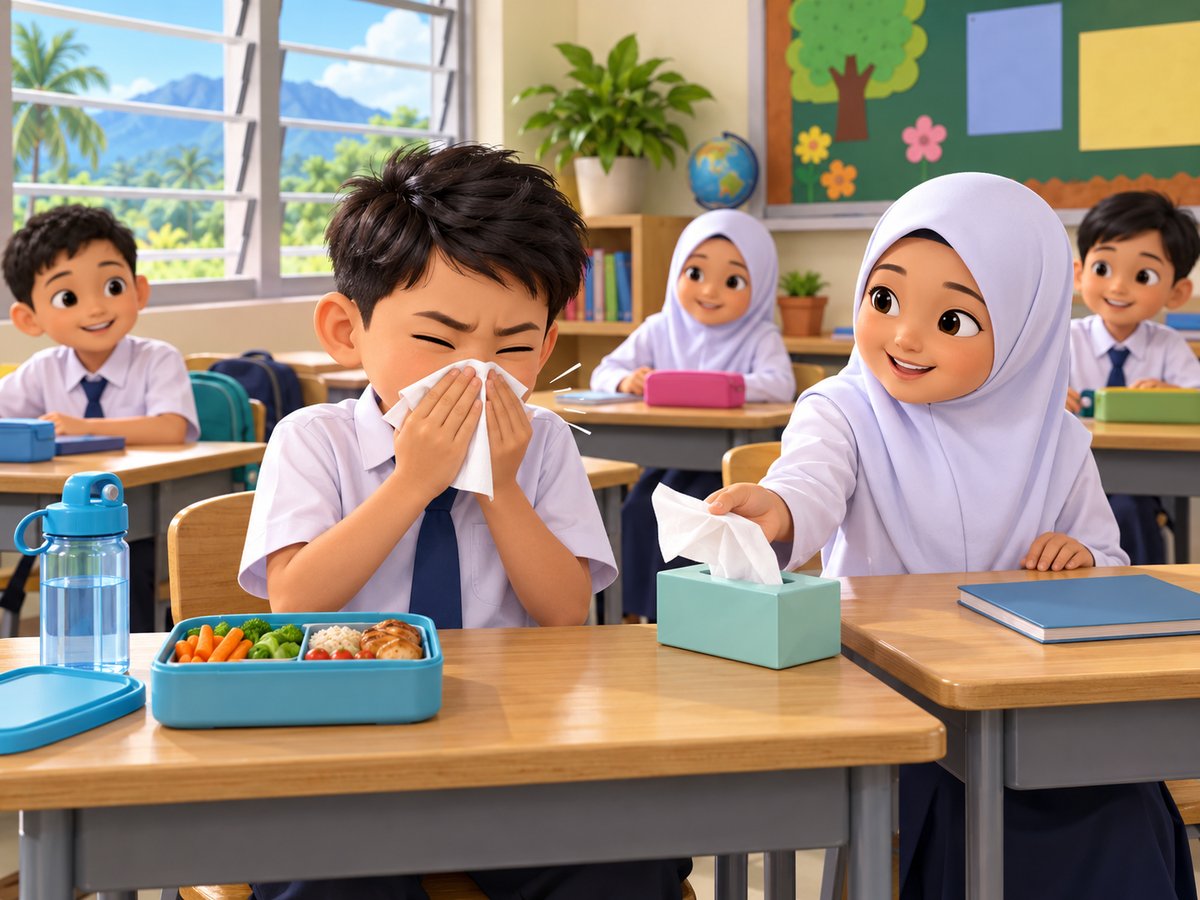
Hafiz bersin di dalam kelas tanpa menutup mulut. Rakan sebelahnya menegur dengan sopan dan menghulurkan tisu. Kesihatan kita bermula dengan amalan yang baik.
I am healthy = saya sihat
This unit is about health: politely reminding others about cough etiquette, reading blood donation rules, eye care, a health pantun, measure words (penjodoh bilangan) and transitive verbs.
Example: a classmate sneezes without covering his mouth; his friend politely reminds him and offers a tissue.
Watch out: give a reason and stay polite when reminding someone.
Mendengar dan Bertutur
Menegur dengan sopan
Apabila menegur, gunakan kata maaf dan berikan alasan.
Contoh: "Maaf, Hafiz. Kamu perlu menutup mulut ketika bersin. Amalan ini bertujuan mengelakkan jangkitan penyakit."
有礼貌地提醒 = menegur dengan sopan
提醒别人时,先说 maaf(对不起),再说应该怎么做,最后说明原因(bertujuan…… 目的是……)。
例子:“对不起,Hafiz。你打喷嚏时要遮住嘴巴,这样可以避免传染疾病。”
注意:不要大声责骂,要顾及对方的感受。学了这个,试着用它造两三个自己的句子,说给家人听。
reminding politely = menegur dengan sopan
When reminding someone, start with maaf (sorry), say what they should do, then give the reason (bertujuan... means "the aim is...").
Example: "Sorry, Hafiz. Please cover your mouth when you sneeze. This prevents spreading germs."
Watch out: do not scold loudly; consider the other person's feelings.
the politest reminder = teguran sopan
A polite reminder has maaf, a suggestion and a reason. Which sentence has all three?
Example: "Sorry, please queue so everyone gets a fair turn."
Watch out: insulting someone or refusing to sit with them is not polite.
Membaca dan Menulis
Menjaga kesihatan mata
Untuk menjaga mata: membaca dalam cahaya yang cukup, mengehadkan masa menggunakan skrin, berehat setiap 20 minit dan makan sayur yang kaya dengan karotena seperti lobak merah.
Contoh: Senaman mata: pandang jauh, kelip mata perlahan-lahan, kemudian pejamkan mata seketika.
保护眼睛 = kesihatan mata
护眼方法:在光线充足的地方看书、限制看屏幕的时间、每 20 分钟休息一下、多吃含胡萝卜素(karotena)的蔬菜,例如红萝卜。也可以做眼睛运动:望远、慢慢眨眼、闭眼休息。
例子:做眼睛运动:先望远,再慢慢眨眼,然后闭眼一会儿。
注意:回答理解题时,要从文章里找出答案,用完整句子写。
caring for the eyes = kesihatan mata
Eye care: read in good light, limit screen time, rest every 20 minutes and eat vegetables rich in carotene (karotena) such as carrots. Eye exercises: look far away, blink slowly, then close the eyes for a moment.
Example: eye exercise: look far, blink slowly, then close the eyes briefly.
Watch out: answer comprehension questions from the text in full sentences.
Pilih semua
Pilih semua cara menjaga kesihatan mata.
护眼方法 = cara jaga mata
逐一想:哪些做法让眼睛休息、得到营养?在暗处看书、整夜玩手机会伤眼。这题有几个答案。
例子:每看屏幕 20 分钟,就望远 20 秒。
注意:光线太暗,眼睛容易疲劳。平时读马来文报纸或故事书时,留意有没有用到这一点。
eye care habits = cara jaga mata
Think about each: which habits rest or nourish the eyes? Reading in the dark and using a phone all night harm them. There are several answers.
Example: every 20 minutes of screen time, look far away for 20 seconds.
Watch out: dim light tires the eyes quickly.
Membaca
Syarat menderma darah
Seseorang boleh menderma darah jika sihat, berumur 18 hingga 60 tahun, beratnya sekurang-kurangnya 45 kg dan cukup tidur sebelum menderma.
Contoh: Isi Peta Bulatan: tulis "Penderma darah" di tengah, kemudian tulis syarat-syarat di sekelilingnya.
blood donation rules = syarat menderma darah
Donating blood saves lives. A donor must be healthy, aged 18 to 60, weigh at least 45 kg and have slept well the night before. After reading, sort the facts in a circle map (Peta Bulatan): the topic in the middle and the conditions around it.
Example: middle: "blood donor"; around it: healthy, 18–60, at least 45 kg, enough sleep.
Watch out: pupils are too young to donate, but can encourage adults to.
who can donate = siapa boleh menderma
Compare each person with the rules: aged 18 to 60, healthy, and at least 45 kg. If even one rule is not met, that person cannot donate. Check all three people one by one.
Example: a healthy 25-year-old weighing 55 kg can donate.
Watch out: 16 is too young, and someone with a fever cannot donate.
Seni Bahasa
Pantun empat kerat
Pantun empat kerat mempunyai pembayang (baris 1–2) dan maksud (baris 3–4). Contoh pantun ciptaan: Pergi ke kedai membeli kopi, / Kopi dibawa ke dalam bilik; / Rambut disikat kemas dan rapi, / Tanda diri dijaga baik.
Contoh: Baris 3 dan 4 membawa mesej menjaga kebersihan diri.
four-line pantun = pantun empat kerat
A pantun has a pembayang (lines 1–2, a lead-in) and a maksud (lines 3–4, the real message). Above is a pantun about tidiness.
Example: lines 3 and 4 say: hair combed neatly shows you take good care of yourself.
Watch out: lines 1 and 3, and lines 2 and 4, should rhyme at the end.
Semak kefahaman
Dalam pantun empat kerat, baris manakah membawa maksud?
pantun 的意思 = maksud pantun
pantun 先用两行引子,后两行才说出真正的意思。
例子:“Rajin belajar setiap hari, / Pasti berjaya suatu hari.”就是 maksud 部分。
注意:第一、二行是 pembayang。把例句大声朗读两三次,注意发音和语调。
the meaning lines = maksud pantun
A pantun opens with two lead-in lines; the last two give the real message.
Example: "Study hard every day, / You will succeed one day." would be the maksud part.
Watch out: lines 1 and 2 are the pembayang.
Tatabahasa
Penjodoh bilangan dan kata kerja transitif
Penjodoh bilangan digunakan bersama bilangan: sebuah rumah, sehelai kain, sebiji epal, sekeping roti, seorang doktor. Kata kerja aktif transitif memerlukan objek: Kak Ros menggoreng ikan.
Contoh: Ibu membeli dua botol ubat batuk di farmasi.
量词与及物动词 = penjodoh bilangan dan kata kerja transitif
马来语数东西要用量词:buah(房子、车)、helai(布、纸)、biji(圆形小物)、keping(扁平物)、orang(人)、botol(瓶)。及物动词后面一定要有宾语(objek),例如 menggoreng ikan(煎鱼)。
例子:妈妈在药房买了两瓶咳嗽药。
注意:量词要配对:sehelai baju,不是 sebuah baju。把新学的词语做成小卡片,正面写马来文,背面写意思。
measure words and transitive verbs = penjodoh bilangan dan kata kerja transitif
Malay counts things with measure words: buah (houses, cars), helai (cloth, paper), biji (small round things), keping (flat things), orang (people), botol (bottles). A transitive verb needs an object, e.g. menggoreng ikan (fry fish).
Example: Mother buys two bottles of cough medicine at the pharmacy.
Watch out: match the measure word: sehelai baju, not sebuah baju.
matching measure words = padankan
A slice of bread is flat: keping. Cloth comes in sheets: helai. A doctor is a person: orang.
Example: sebiji telur (one egg).
Watch out: think about the shape of the thing first.
Ringkasan
Syabas!
Saya sihat
Tegur dengan kata maaf dan alasan. Jaga mata dengan berehat dan makan lobak merah. Pantun ada pembayang dan maksud. Penjodoh bilangan seperti sebuah, sehelai, sebiji; kata kerja transitif memerlukan objek.